Blog
November 4, 2026

von
Andrej Evtimov
Six fields that make a notice usable, and what it almost never captures.
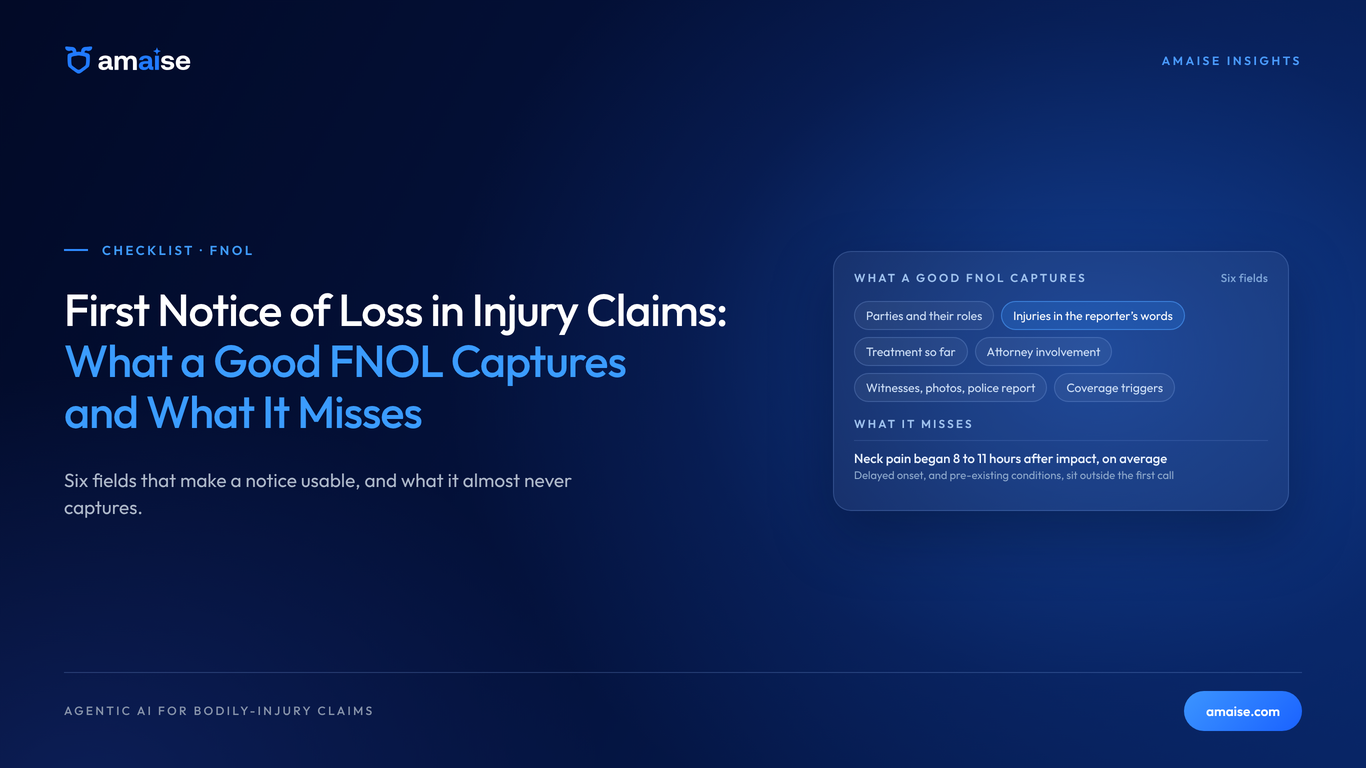
The first notice of loss sets the direction of an injury file, but it records only what was known on day one. This guide shows what a good FNOL captures, what it usually misses, and how to follow up before investigation starts.
What first notice of loss means in an injury claim
First notice of loss (FNOL) is the first report to the carrier that an accident happened and someone may be hurt. It can come from the insured, the claimant, a broker, an attorney or an agent forwarding a police report. In an injury claim, it is the moment the file starts.
The FNOL is a snapshot. It records what the reporter knew on the day they called, which is rarely the whole story. Bodily injury exposure often develops after the report, as symptoms, treatment and representation change.
The clock also starts here. The NAIC Unfair Property/Casualty Claims Settlement Practices Model Regulation is a model for states, not binding law in itself. It calls for acknowledging a notice of claim within 15 days, unless payment is made in that time. It also expects file documentation detailed enough to reconstruct what the insurer did and when.
States adopt their own versions, and periods and day counts differ. Delaware's regulation, for example, counts working days rather than calendar days. Confirm the current rule for the loss state with counsel.
That makes the FNOL two things at once. It is an intake record, and it is the first entry in the documentation trail.
What a good FNOL captures in injury claims
A strong injury FNOL does not try to value the claim. It collects facts that are cheap to get on day one and expensive, or impossible, to get later.
Parties and their roles
List every person involved, not only the one who called. That means drivers, passengers, vehicle owners, pedestrians, the named insured and any employer if someone was working at the time. Record contact details, dates of birth, and who was in which seat or position.
Dates of birth matter for a practical reason. Section 111 of the Medicare, Medicaid, and SCHIP Extension Act of 2007 (MMSEA) requires liability insurers and self-insurers to report certain claims involving Medicare beneficiaries. The reporting party is called a Responsible Reporting Entity, and it can run an optional query to check Medicare status first.
CMS Section 111 query file training lists the query fields: the injured party's SSN or Medicare ID, plus name, date of birth and gender. Capturing them early avoids chasing them at settlement.
Injuries reported, in the reporter's words
Write down the injuries as the reporter described them. "My neck hurts" and "whiplash" are not the same entry, and the difference matters later. Note who described the injury: the claimant, the insured or a bystander.
Record what was not reported, too. "No injury claimed at the scene" is a useful fact if a claim appears weeks later. It is a fact about that day, not a finding about the claimant.
Treatment so far
Capture whether anyone was transported by ambulance, seen in an emergency department, admitted, or treated by their own doctor. Get the facility names and the dates. Those names drive the first records requests.
Early severity signals belong here: ambulance transport, hospital admission, emergency imaging or surgery. Signals like these can help a supervisor decide whether a file needs a senior adjuster or an early large loss review.
Attorney involvement
Ask whether anyone has spoken with a lawyer, and record any letter of representation with its date. In many jurisdictions, carriers route contact through counsel once representation is confirmed. Check state rules and company guidelines before contacting a represented claimant.
Representation can also arrive early. A July 2026 Insurance Research Council survey, reported by Insurance Business, found nearly half of those who hired an attorney did so within days. About eight in ten who consulted or hired a lawyer reported a referral to a medical provider.
Witnesses, photos and the police report
Witness names and phone numbers fade fast. So do phone photos, dashcam clips, and store or traffic video that gets overwritten. The FNOL should list what exists and who holds it, so preservation requests go out quickly.
The police report needs careful reading. Many state crash forms use the KABCO injury scale from the Model Minimum Uniform Crash Criteria, a voluntary guideline published by NHTSA. The codes run K (fatal), A (suspected serious injury), B (suspected minor injury), C (possible injury) and O (no apparent injury).
A "C" covers injuries reported or claimed without visible wounds, such as a complaint of pain. It is an officer's rating at the scene, not a diagnosis. State crash forms and their injury status definitions vary, so read the narrative as well as the code.
Coverage triggers
Record the facts that decide which coverage responds. Date, time and place test the policy period and territory. The vehicle, the driver and the question of permission test who is insured.
Note other coverages that may respond first or alongside. Depending on the state, these include personal injury protection, medical payments, and uninsured or underinsured motorist coverage. If someone was working, a workers' compensation carrier may be involved. Flag late notice or unclear permissive use for coverage review rather than deciding it at intake.
Field-by-field FNOL checklist for injury claims
The table below shows where FNOL insurance data usually thins out. It is a starting checklist, not a complete intake form.
- Every person involved, with date of birth. Why it matters later: Separates claimants; supports a Medicare status query. Common gap at intake: Only the caller is recorded.
- Injury description, verbatim. Why it matters later: Compared against the first medical record. Common gap at intake: Paraphrased into a diagnosis.
- First treating facilities and dates. Why it matters later: Drives the first records requests. Common gap at intake: "Went to the hospital," no name.
- Attorney contact or representation date. Why it matters later: Contact rules; early demand watch. Common gap at intake: Never asked.
- Witnesses and video holders. Why it matters later: Preservation before footage is lost. Common gap at intake: "Witnesses: unknown".
- Police report number and agency. Why it matters later: KABCO code, narrative, citations. Common gap at intake: Number missing.
- Vehicle, driver, permission, policy period. Why it matters later: Coverage position. Common gap at intake: Assumed, not confirmed.
- Work status at the time of loss. Why it matters later: Possible workers' compensation involvement. Common gap at intake: Never asked.
What a first notice of loss typically misses
Even a careful intake misses things. Most gaps in FNOL claims are not errors. They are facts that did not exist yet, or that nobody on the call knew.
Delayed-onset symptoms
Neck pain after a car crash does not always start at the scene. A 2022 perspective article in Frontiers in Neurology cites earlier data from Radanov and colleagues. In that cohort, neck pain began on average about 8 to 11 hours after impact.
So "no injury at scene" followed by an emergency visit the next day is not a warning sign by itself. The useful step is to fix the timeline: when symptoms started, when treatment started, and what happened in between. Medical opinion on causation varies, and the records decide it, not the FNOL.
Pre-existing conditions
A claimant may not mention a degenerative spine on a claim call, and may not know about one. Imaging findings are common in people with no symptoms. A 2015 systematic review in the American Journal of Neuroradiology found disc degeneration in 37% of symptom-free 20-year-olds and 96% of 80-year-olds.
The FNOL cannot answer the prior-condition question. It can collect what makes the answer findable later: prior claims, prior injuries, and the claimant's usual doctors.
Later attorney representation
A claim reported as unrepresented may not stay that way. Given how fast counsel can enter, treat a letter of representation as a dated event that may change contact rules.
The IRC's auto injury claim study covered claims closed from mid-2017 to mid-2022. Over that period, the share of claimants with attorneys rose from about 40% to nearly 50%. Represented bodily injury claims also closed more slowly: a median of nearly 440 days, more than double unrepresented claims. The figures show an association, not the reason for it.
A represented claimant may also send an early demand with a short deadline. A 30-day playbook for time-limited demands covers that response. At intake, the point is simply to know counsel is involved.
Treatment that has not happened yet
The FNOL records treatment to date, which is often a single emergency visit. It cannot record the physical therapy, injections, imaging or surgical consult that may follow. An opening reserve set on that snapshot may need correction, a pattern covered in how early file review changes reserve development.
Treat the first treatment record as a starting point. The question is not only what treatment happened, but what treatment path is opening.
Illustration: one file on day 1, day 9 and day 30
The following is a hypothetical example, not a real claim. On day 1, an insured reports a rear-end collision. The other driver declined an ambulance and said only that her neck felt stiff. The FNOL records "no injury claimed at scene" and no treatment.
On day 9, a letter of representation arrives. It notes that the claimant visited urgent care the morning after the crash. On day 30, counsel mentions a cervical MRI and a physical therapy referral.
None of this contradicts the FNOL. Each fact simply did not exist, or was not known, on day 1. A file that dates each event can show when the carrier learned what.
Practical follow-up steps after first notice of loss
The gaps above are predictable, so the follow-up can be standard. The steps below are a common pattern for the early weeks of an injury file. Adapt the timing to company guidelines and state rules.
- Acknowledge the claim inside the deadline that applies in the loss state, and note the date.
- Contact the claimant, or counsel where the claimant is represented, and confirm the injury description.
- Order the police report and read the narrative, not only the injury code.
- Send preservation letters for video, dashcam footage and vehicle data, and request records from the first treating facilities.
- Collect the identifiers your Section 111 process needs for a Medicare status check.
- Ask about prior injuries and prior claims, and record prior treating providers.
- Diary a follow-up call to capture new treatment or a new lawyer.
- Set or adjust the initial reserve, with a written note of the facts behind it.
- Route coverage questions, such as late notice or permission, to coverage review.
Each step leaves a dated note. Together they show that the carrier acted promptly on what it knew, and looked for what it did not.
Where FNOL ends and investigation begins
The FNOL is complete when the file holds enough facts to start an investigation, not when the claim is understood. Liability, medical causation, damages and negotiation belong to the later stages of the bodily injury claim.
A clean handoff has a few marks:
- Every person involved is listed, with contact details.
- Every first treating facility is named, with a records request out.
- Representation status is recorded and dated.
- Evidence holders have received preservation letters.
- Coverage questions are flagged, with an owner.
As records arrive, the work shifts to reading them in date order. A medical chronology built from the claim file is the usual next tool. On auto files, amaise organizes police reports, medical records and legal documents for motor liability claim review, and the adjuster still makes the call.
A first notice of loss will always be incomplete. The adjuster's job at intake is to capture what will disappear, flag what is missing, and set the follow-ups that fill the gaps. A good FNOL does not settle anything, but it makes every later decision easier to support.
Frequently asked questions
What is first notice of loss in an injury claim?
First notice of loss (FNOL) is the first report to the carrier that an accident happened and someone may be hurt. It records what the reporter knew on that day, which is rarely the full injury exposure.
What should a good FNOL capture for a bodily injury claim?
A good FNOL lists every person involved, with contact details and dates of birth, and records injuries in the reporter's own words. It also notes first treatment, facility names and any attorney contact. Witnesses, evidence holders, the police report number and coverage facts complete the record.
What does an FNOL usually miss?
It usually misses symptoms that start hours or days after the accident, and pre-existing conditions. It also misses attorney representation that arrives later, and treatment that has not happened yet, such as therapy, imaging or a surgical consult.
Is the KABCO code on a police report a medical finding?
No. KABCO is the injury scale many state crash forms use, based on the Model Minimum Uniform Crash Criteria, a voluntary NHTSA guideline. A "C" (possible injury) covers a reported or claimed injury with no visible wound. It is an officer's rating, not a diagnosis.
This article is general information, not legal or medical advice. Confirm current state law with counsel and follow company guidelines.
Key takeaways
- A first notice of loss is a snapshot: it records what the reporter knew on day one, not the full injury exposure.
- A good FNOL captures every person involved, injuries in the reporter's words, first treatment, attorney contact, evidence holders and coverage facts.
- FNOL claims typically miss delayed-onset symptoms, pre-existing conditions, later attorney representation and treatment that has not happened yet.
- A police KABCO injury code is an officer's scene rating, not a medical diagnosis.
- Structured, dated follow-up in the first weeks closes the gaps before the file moves to investigation.