Blog
November 4, 2026

von
Andrej Evtimov
Four reasons to order an exam, and the six parts of the report that carry the weight.
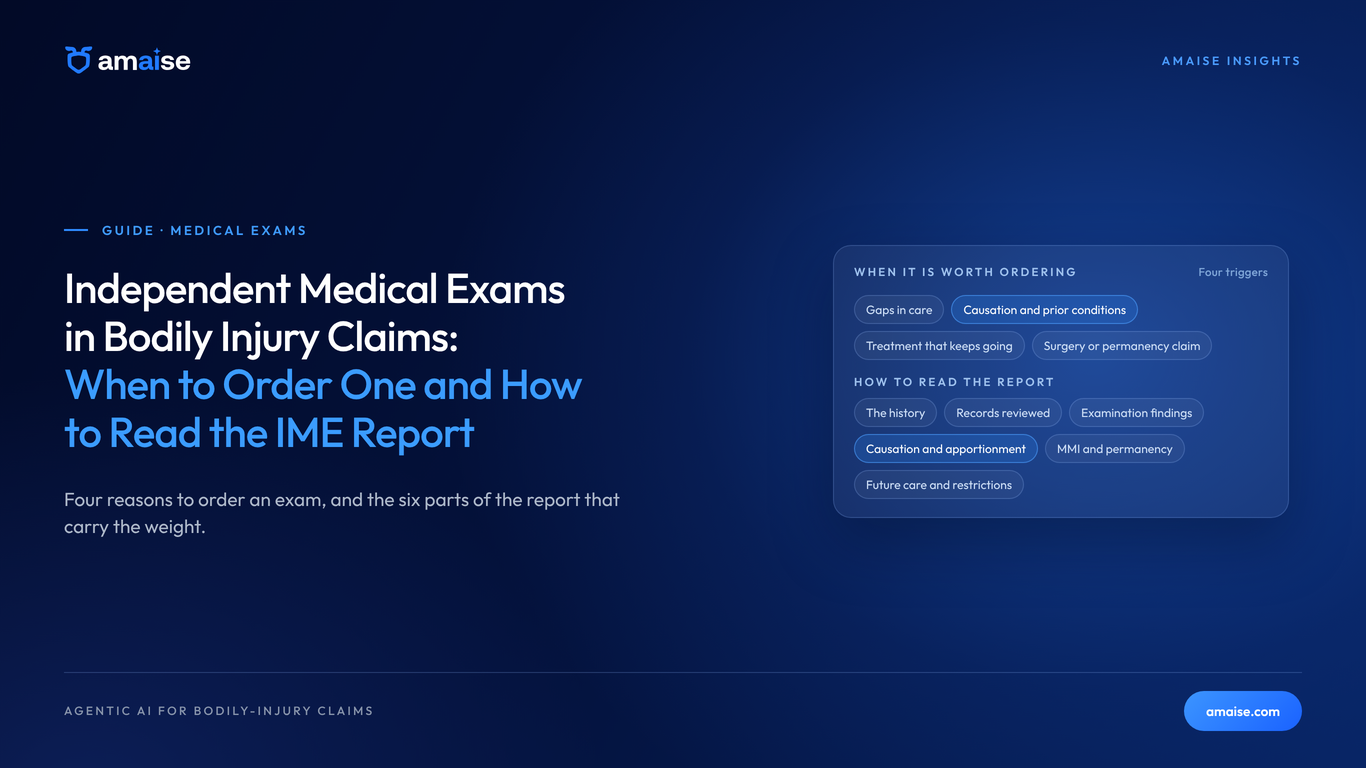
An independent medical examination can answer the medical questions that treating records leave open, if it is ordered for the right reason and read closely. This guide covers when to request one, how the request works and what to check in the IME report.
What an independent medical examination is, and what it is not
An independent medical examination (IME) is an evaluation of a claimant by a physician who does not treat them. The carrier, an employer or a defendant usually arranges it. It answers questions the treating records leave open: diagnosis, causation, need for further care and permanency.
The word "independent" describes the doctor's relationship to the patient. It does not mean the doctor is neutral in the dispute. For that reason, some plaintiff lawyers call it a "defense medical examination."
An IME is also more than a records review. It adds a history taken from the claimant and a physical or mental examination. That exam gives the opinion weight, and it makes the request harder to get.
When an independent medical exam is worth ordering
An independent medical exam costs money and time. It also gives the claimant's side a preview of your medical theory. Order one when the file has a specific medical question that the existing records cannot answer.
The best signals usually come out of a full medical chronology. If you have not built one yet, start with how to build a medical chronology from a long claim file. The triggers below show up as patterns on that timeline.
Gaps in care
A claimant treats for three weeks, stops for four months, then returns with worse complaints. Something may have happened in between, or the injury may have resolved. An examiner can take a history on the gap and say whether later treatment relates back.
Causation questions and prior conditions
Imaging can show degenerative findings alongside the claimed injury. Prior treatment for the same body part may sit in old records under a different label. When the dispute is acute injury versus pre-existing condition, an IME doctor can address both. For the imaging side, see how to read the MRI report when the question is acute or degenerative.
Treatment that keeps going
Physical therapy past the expected recovery window, repeated injections or open-ended chiropractic care all invite one question. Is the treatment still reasonable and necessary, and is it still related to the loss? The treating provider wrote the plan of care, so an outside opinion helps test it.
A surgery recommendation or permanency claim
A surgical recommendation can change the value of a file sharply. If it rests on disputed imaging or a short course of conservative care, consider an exam before surgery. Permanency claims and future care plans call for the same early look.
When to hold off
Early in active treatment, the condition may still be changing. Permanency opinions generally assume it has stabilized, which is the idea behind maximum medical improvement, covered below. An exam ordered on an incomplete record set invites attack as uninformed.
How the exam is requested: policy conditions versus court rules
The right to an exam depends on the relationship between the carrier and the person examined. First-party and no-fault claims run on the policy. Third-party claims in suit run on court rules. Workers' compensation exams follow separate state systems that this guide does not cover.
The examples below show how much the rules vary. They are not a survey of every state, so confirm current law in each jurisdiction with counsel.
- PIP or no-fault claim. Where the right to an exam comes from: Policy condition and state no-fault law. Who asks: The carrier. Notable limits: Notice, timing and cost rules vary by state.
- UM/UIM or med-pay claim. Where the right to an exam comes from: The policy wording for that coverage. Who asks: The carrier. Notable limits: Check the coverage part for an exam condition.
- Federal lawsuit. Where the right to an exam comes from: Court order under FRCP 35. Who asks: Defense counsel, by motion. Notable limits: Condition in controversy and good cause.
- California personal injury lawsuit. Where the right to an exam comes from: Demand under CCP 2032.220, or a court order. Who asks: Defense counsel. Notable limits: One demand exam, no intrusive tests, 75-mile limit.
- Third-party claim before suit. Where the right to an exam comes from: No policy or court rule binds the claimant. Who asks: The carrier, by request. Notable limits: Usually depends on the claimant agreeing.
First-party and PIP claims: the policy condition
Personal injury protection (PIP) and no-fault policies often include an exam condition, and some state laws set it out directly. Uninsured and underinsured motorist (UM/UIM) and medical payments claims are first-party too. Check those coverage parts for an exam condition before asking.
New York is one example. Its Appellate Division held that appearing for IMEs is a condition precedent to the insurer's liability under the mandatory PIP endorsement in 11 NYCRR 65-1.1. That 2006 holding, in Stephen Fogel Psychological, P.C. v. Progressive, was quoted again in Mapfre Ins. Co. of N.Y. v. Manoo (2016). Courts also look at whether the carrier sent its exam notices within the regulation's time frames. A missed exam does not help a carrier that cannot prove its own notices.
Florida's PIP statute takes a similar approach. Section 627.736(7) requires the injured person to submit to an exam when their condition is material to the claim. The insurer bears the cost. Under the same subsection, an unreasonable refusal to attend ends the carrier's liability for later PIP benefits. Section 627.736 has been amended many times, so confirm the current text with counsel.
Third-party claims in litigation: Rule 35 and state rules
A third-party claimant is not a party to the carrier's policy. Before suit, an exam usually depends on the claimant agreeing to one.
In federal court, Federal Rule of Civil Procedure 35 governs. The court may order a party whose physical or mental condition is "in controversy" to be examined. The motion must show good cause and give notice. The order sets the time, place, manner, conditions, scope and examiner.
The Supreme Court read those requirements strictly in Schlagenhauf v. Holder, 379 U.S. 104 (1964). Conclusory allegations in the pleadings do not satisfy them, and neither does mere relevance. The movant must show that each condition is genuinely in controversy and that good cause exists for each exam requested.
State court rules set their own terms, and some differ sharply from Rule 35. California is a useful contrast. Under Code of Civil Procedure section 2032.220, a defendant in a personal injury case may demand one physical exam without a court order. The exam cannot include a painful, protracted or intrusive test. It must take place within 75 miles of the examinee's residence.
California also lets the examinee's attorney attend a physical exam. Under section 2032.510, the attorney may record by audio or stenographically what is said to or by the examinee. The observer may not take part in or disrupt the exam. Assume the IME doctor's words may be on a recording.
Once suit is filed, defense counsel drives the request. Make sure counsel knows which medical questions the exam must answer.
Choosing an IME doctor and what to send them
The choice of IME doctor shapes what the report is worth at deposition.
Match the specialty to the question
The specialty should fit the disputed issue. A spinal surgery recommendation calls for a spine surgeon or orthopedist. A cognitive complaint after a head injury may call for a neurologist or neuropsychologist. Rule 35 allows exams by a "suitably licensed or certified examiner," so non-physicians can qualify in federal court. State statutes and policies may set their own requirements.
Check what the other side will check
Plaintiff counsel will check the examiner's testimony history and how often they work for defendants. An examiner who mostly testifies for one side is easy to attack. Ask for that history before you book.
Send the full record and specific questions
The examiner can only weigh what they receive. Send the complete medical record, prior records for the same body part, imaging reports and films where possible, and the accident facts. Missing records are a common ground for attacking an IME report.
Then write specific questions. Vague requests produce vague reports. Useful questions include:
- What is the diagnosis, and what objective findings support it?
- Within a reasonable degree of medical probability, did the loss cause the condition, aggravate a prior condition, or neither?
- Was the treatment to date reasonable, necessary and related to the loss? From what date, if any, was it not?
- Has the claimant reached maximum medical improvement? If not, when is it expected?
- Is any future care reasonably necessary, and what is it?
How to read the IME report
Rule 35 gives a useful baseline for what an IME report should contain. The report must be in writing and set out the examiner's findings in detail, including diagnoses, conclusions and the results of any tests. Read every report against that standard, in or out of court.
The history
Compare the history the claimant gave the examiner with the history in the treating records. Differences matter in both directions. A claimant who denies prior back treatment that the records show creates a credibility issue. An examiner who records the history wrongly creates a problem for the report.
Records reviewed
The report should list every record the examiner reviewed. Check that list against what you sent. If the examiner did not see the prior records or the latest imaging, the causation opinion is exposed. Fix it with an addendum before anyone relies on the report.
Examination findings
Look for objective findings: range of motion, reflexes, strength, imaging correlation. A finding stated without the test behind it is weaker than one with the method shown.
Causation and apportionment
This is the core of most reports. The opinion should explain why, not just conclude. Most reports frame causation in terms of reasonable medical probability, though the required wording varies by state.
California workers' compensation shows what an appeals board can require. In Escobedo v. Marshalls, a 2005 en banc decision, the Workers' Compensation Appeals Board set three tests for an apportionment opinion. It must be framed in reasonable medical probability, rest on an adequate history and examination, and explain its reasoning. Those tests bind only California workers' compensation, but they make a useful checklist for reading any IME report.
Watch for three common outcomes. The loss caused the condition. The loss aggravated a pre-existing condition, possibly for a limited period. Or the condition is unrelated. An aggravation opinion is only useful if it says when the aggravation ended or how much of the current condition it explains.
Apportionment rules differ sharply by line of business and state. Workers' compensation often has its own statutory scheme. For how that plays out, see workers' comp apportionment and finding the prior injury before the IME does.
Maximum medical improvement and permanency
Maximum medical improvement (MMI) generally means the condition has stabilized and further material recovery is not expected. Definitions vary, and some add a time limit. Texas workers' compensation, for example, uses both a clinical test and a time-based endpoint.
The clinical test asks when further material recovery or lasting improvement can no longer reasonably be anticipated. The time-based endpoint is 104 weeks after income benefits begin to accrue. A 2021 Texas workers' compensation appeals panel decision quotes both parts of Labor Code section 401.011(30). Check which definition, and which edition of any impairment guide, applies in your jurisdiction.
The report should give an MMI date or explain why MMI has not been reached. Any impairment rating should name its method.
Future care and restrictions
Read the future care section against the life care plan or demand. Note which items the examiner accepts or rejects, and why. Check that any work restrictions are specific.
Where IME reports fall short, and how they get challenged
An IME report is one physician's opinion on one day. It carries real limits, and the other side will press every one of them.
Research on disability evaluations shows how often experts can disagree. A 2017 systematic review in the BMJ examined 23 studies from 12 countries on work disability evaluations. Agreement between experts assessing the same claimants was low in insurance settings and higher in research settings. Reliability was higher when a standardized instrument guided the evaluation. Those studies did not cover bodily injury IMEs, but the risk of disagreement is worth planning for.
Common grounds for challenge include:
- Incomplete records. The examiner did not see key treatment or imaging.
- Conclusions without reasons. The opinion states causation but does not explain it.
- Scope creep. The report addresses issues the exam did not cover.
- Examiner history. Testimony patterns and repeat work for one side.
Treating physicians often disagree with the IME doctor, and they have seen the claimant for months. The answer is a report built on more of the record, with clearer reasoning.
Bad-faith and fair claims practice risk
How a carrier uses an IME can also surface in a bad-faith claim. The NAIC's Unfair Claims Settlement Practices Act lists one unfair practice directly. It is not attempting in good faith a prompt, fair and equitable settlement where liability is reasonably clear.
The NAIC's claims settlement model regulation expects claim files detailed enough to reconstruct the insurer's activities. Note why each IME was ordered, why that examiner was chosen and how the report was weighed against the treating records. States adopt these models in their own form, so check local rules with counsel.
Frequently asked questions about independent medical examinations
When should an adjuster order an independent medical examination?
When the file has a specific medical question the treating records cannot answer. Common triggers are a gap in care, disputed causation, treatment that keeps going and a surgery recommendation. Early in active treatment, an exam may say little about permanency.
Can a carrier require a claimant to attend an IME?
It depends on the relationship. In PIP and no-fault claims, the policy and state law often require the insured to attend reasonable exams. In litigation, court rules such as FRCP 35 apply. Before suit, a third-party claimant has no policy with the carrier, so an exam usually depends on their agreement. Confirm the rules in each state with counsel.
What does FRCP 35 require for a court-ordered medical exam?
The party's physical or mental condition must be in controversy. The motion must show good cause and give notice, and the order sets the time, place, manner, conditions, scope and examiner. In Schlagenhauf v. Holder (1964), the Supreme Court held that conclusory allegations in the pleadings do not meet these requirements.
What should an IME report contain?
Under FRCP 35, the report must be in writing and set out the examiner's findings in detail, including diagnoses, conclusions and test results. Adjusters should also check the history, the records reviewed, the causation and apportionment reasoning, MMI status and any future care opinion.
Why do IME reports get challenged?
Common grounds include incomplete records, conclusions without reasons, opinions beyond the exam's scope and the examiner's testimony history. A 2017 BMJ review of work disability evaluations also found low agreement between experts in insurance settings.
Putting the IME report to work in the claim file
The independent medical examination is a tool for the file, not a verdict on it. A clear report helps set reserves, frame a negotiating position and document the reasons for paying or disputing treatment. Note in the file what question each IME answered and how the report changed the evaluation.
Reading an IME report well depends on knowing the full medical record first. Causation questions in liability files often turn on the same records, as covered in what the medical records say about causation in premises liability claims. On the amaise platform, bodily injury claim file review organizes those records and flags key details, with each output linked to its source page. The adjuster still reads the report and makes the call.
Order an independent medical examination for a specific medical question. Send the examiner everything. Then read the IME report line by line against the record.
This post is a general guide for claims professionals, not medical or legal advice. Rules on medical examinations differ by state, by line of business and by forum.
Key takeaways
- Order an independent medical examination for a specific question: a gap in care, disputed causation, open-ended treatment or a surgery recommendation.
- The right to an exam comes from the policy in PIP and no-fault claims, and from FRCP 35 or state court rules in litigation.
- Match the IME doctor's specialty to the disputed issue and send the full record with written questions.
- Read the IME report for the history, records reviewed, objective findings, causation reasoning, MMI and future care.
- Expect challenges on incomplete records, unexplained conclusions and examiner history.