Blog
September 27, 2026

by
Andrej Evtimov
The records that settle the disability split are usually in the file before the evaluator opens it.
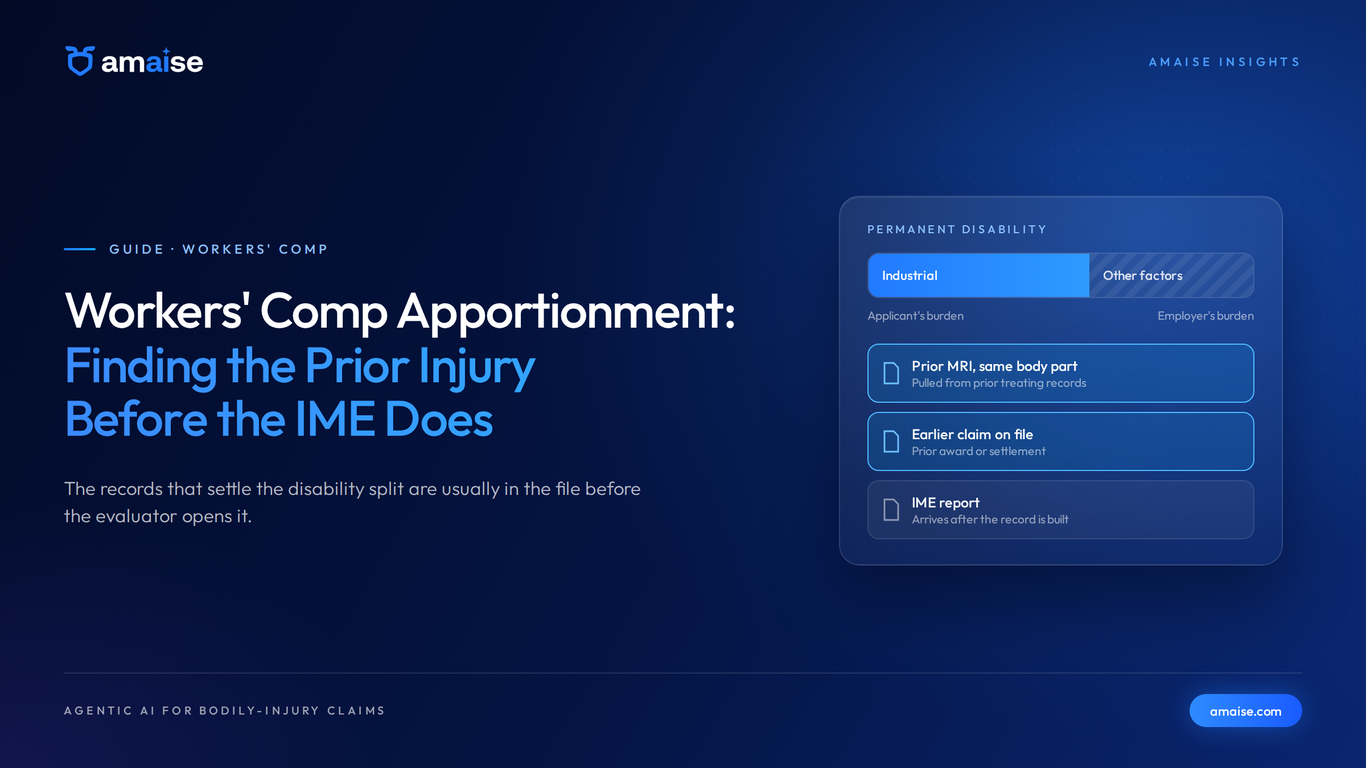
Apportionment decides what share of a permanent disability the employer actually pays. The evidence that settles it is usually sitting in records you can pull before the evaluator ever opens the file.
Apportionment asks a different question than compensability
Compensability asks whether work caused the injury. Apportionment asks what caused the permanent disability that is left at the end.
California's Labor Code makes the split explicit. Section 4663(a) states that apportionment of permanent disability shall be based on causation.
The Workers' Compensation Appeals Board read that word narrowly in Escobedo v. Marshalls. It is a 2005 en banc decision, and it still binds every panel and judge in the state.
The board held that "causation" in section 4663(a) means causation of the permanent disability. It does not mean causation of the injury. The two analyses may reach different answers on the same file.
That distinction decides money. An accepted claim can still carry heavy apportionment. Accepting the injury concedes nothing about the disability split.
The employer carries the burden on the non-industrial share
Escobedo also divided the burden of proof. The applicant must establish the percentage of permanent disability directly caused by the industrial injury. The defendant must establish the percentage caused by other factors.
Read the second half again. Apportionment is not a defense the record hands you. It is a case you build, and you lose it by default.
The proof also has a required shape. Escobedo held that an apportionment opinion is not substantial evidence unless it meets three tests. It must be framed in terms of reasonable medical probability. It must rest on an adequate history and examination. And it must set out the reasoning behind its conclusions.
The board's own example is blunt. Take a physician who assigns 50% of a back disability to degenerative disc disease. That physician must explain the nature of the disease. The report must then show how and why the disease is causing permanent disability at the time of the exam. It must also show how and why that disease accounts for roughly half.
A percentage with no "how and why" behind it is a number, not evidence. A party can move to strike it, and the file may then rate unapportioned.
Where the prior injury shows up in the records
The evaluator sees what you send. Most of what decides apportionment is already in records you can pull before the exam is scheduled.
Prior treatment under a different label
Old records rarely carry the body part in the header. The prior lumbar problem appears as six physical therapy visits in 2019. Or a chiropractic billing run. Or an urgent care note for "back pain." Or a muscle relaxant refill on a primary care chart.
Search the history by body region and by date. Do not search by claim number. The treatment that matters most is usually the treatment that never became a claim.
Degenerative findings on the current imaging
Degenerative changes on the first MRI after an injury are not, on their own, evidence of the injury. They are evidence of what was there before it. A work injury can still aggravate that condition, which is a separate question for the physician.
Escobedo confirmed that pathology, asymptomatic prior conditions and retroactive prophylactic work preclusions can all support apportionment. A physician's reasoned opinion on those findings can be substantial medical evidence that they caused permanent disability.
The Court of Appeal pushed that further in City of Petaluma v. Workers' Compensation Appeals Board (Lindh), decided 10 December 2018. The court ordered an apportioned award where an underlying asymptomatic condition contributed to the disability. The condition had never disabled the worker before the industrial injury.
These findings are common, not exceptional. The Workers Compensation Research Institute's March 2025 study Degenerative and Comorbid Conditions in Workers' Compensation examined more than 930,000 lost-time claims across 32 states. It found that degenerative conditions and comorbidities coexist with the work injury often enough to raise medical payments, indemnity and temporary disability duration.
A prior award, which carries a presumption
The strongest apportionment evidence is not medical at all. Labor Code section 4664(b) covers the case where the applicant has already received an award of permanent disability. That prior disability is conclusively presumed to exist at the time of a later industrial injury.
Conclusively presumed. No doctor has to agree that it still exists.
Section 4664(c)(1) adds a ceiling. Permanent disability awards for any one body region cannot exceed 100% over the worker's lifetime, outside the total disability rules. The statute names seven regions, including the spine, the upper extremities with shoulders, and the lower extremities with hip joints.
A prior award only helps if you find it. That means looking outside your own claim system, into other carriers, other states and other lines of business.
Loss history from outside workers' comp
Run the industry loss-history search at intake. Then read the auto and liability hits, not only the comp hits.
A shoulder treated after a rear-end collision four years ago can support apportionment. It never touched a comp file, so no comp search will surface it.
The disclosure request the statute already gives you
Section 4663(d) states that an employee who claims an industrial injury shall, upon request, disclose all previous permanent disabilities or physical impairments.
Upon request. Without the request there is no duty, and the request is easy to forget early in the claim. Make it in writing and put it in the file.
Treat the answer as a lead, not as a finding. People forget treatment from a decade ago. They also rarely know which of their old problems a rater would call a permanent impairment.
Building the apportionment record before the exam
The sequence matters more than the effort. Five steps, in order:
- Pull the body-region history. Every provider, every year, for the claimed region and the regions next to it. Include records with no diagnosis attached.
- Run the loss-history search across lines and states. Read the non-comp results.
- Request prior awards and prior rating reports. A stipulated award and its rating string are worth more than a year of medical argument.
- Build one dated timeline. Prior treatment, symptom-free intervals, the index injury, post-injury imaging and restrictions, in a single chronology.
- Send it with the evaluation packet, with a written apportionment question. Ask the evaluator to address each non-industrial factor separately, and to explain the reasoning behind each percentage.
Do this before the exam and the opinion arrives complete. Do it after and you are buying a supplemental report or a deposition. You also pay for the delay, and you argue against an opinion the evaluator has already put in writing.
Apportionment law does not travel
None of the mechanics above are national. States run apportionment on different machinery, and the California model is one of the more developed versions.
Florida works from ratings rather than causation percentages. Section 440.15(5)(b) covers impairment or disability attributable to the accident. It directs that the preexisting condition be apportioned out based on the anatomical impairment rating attributable to that condition. Medical benefits are apportioned the same way.
- Basis of the split. California (LC 4663, 4664): Causation of the permanent disability. Florida (§ 440.15(5)(b)): Anatomical impairment rating of the preexisting condition.
- Who must prove the non-industrial share. California (LC 4663, 4664): The defendant, on the "other factors" percentage. Florida (§ 440.15(5)(b)): The employer or carrier, on the preexisting rating.
- Prior award. California (LC 4663, 4664): Conclusively presumed to still exist (4664(b)). Florida (§ 440.15(5)(b)): No equivalent presumption in the subsection.
- Medical benefits. California (LC 4663, 4664): Not apportioned under these sections. Florida (§ 440.15(5)(b)): Apportioned by the same percentage.
Same evidence, different arithmetic. Check the governing state before deciding what the prior injury is worth on your file.
The bottleneck is reading, not law
Claims managers rarely lose apportionment because they misread a statute. They lose it because the file is too big to read in the time available. Picture a 900-page production that lands 11 days before the exam, with the prior treatment buried under a provider name nobody recognises.
That is a document problem, not a legal one. The amaise agenticAI platform runs specialised agents over the full file, sorts it chronologically, and extracts a structured case profile with click-to-evidence sourcing. Apply that to workers' compensation claim handling and bodily injury claim file review. The prior episode and the degenerative finding surface early enough to reach the evaluator before the exam.
The reviewer still decides what the prior injury means. Apportionment is a judgement about causation of disability. That judgement belongs to the physician and the adjuster. The work that has to happen first is finding the pages, and that work can finish before the IME opens the box.
Key takeaways
- Compensability asks whether work caused the injury. Apportionment asks what caused the permanent disability that remains, and the two answers can differ on the same file.
- Under Escobedo v. Marshalls, the defendant carries the burden on the non-industrial percentage. An unproven prior contribution is a percentage the employer pays.
- An apportionment opinion is only substantial evidence when the physician explains the "how and why" behind each percentage. A bare number can be struck.
- A prior award is the strongest evidence available: California Labor Code 4664(b) conclusively presumes the prior disability still exists.
- Build the body-region history, cross-line loss search, prior awards and a dated timeline before the exam. After the report lands, you are buying a supplemental opinion.
