Blog
novembre 4, 2026

par
Andrej Evtimov
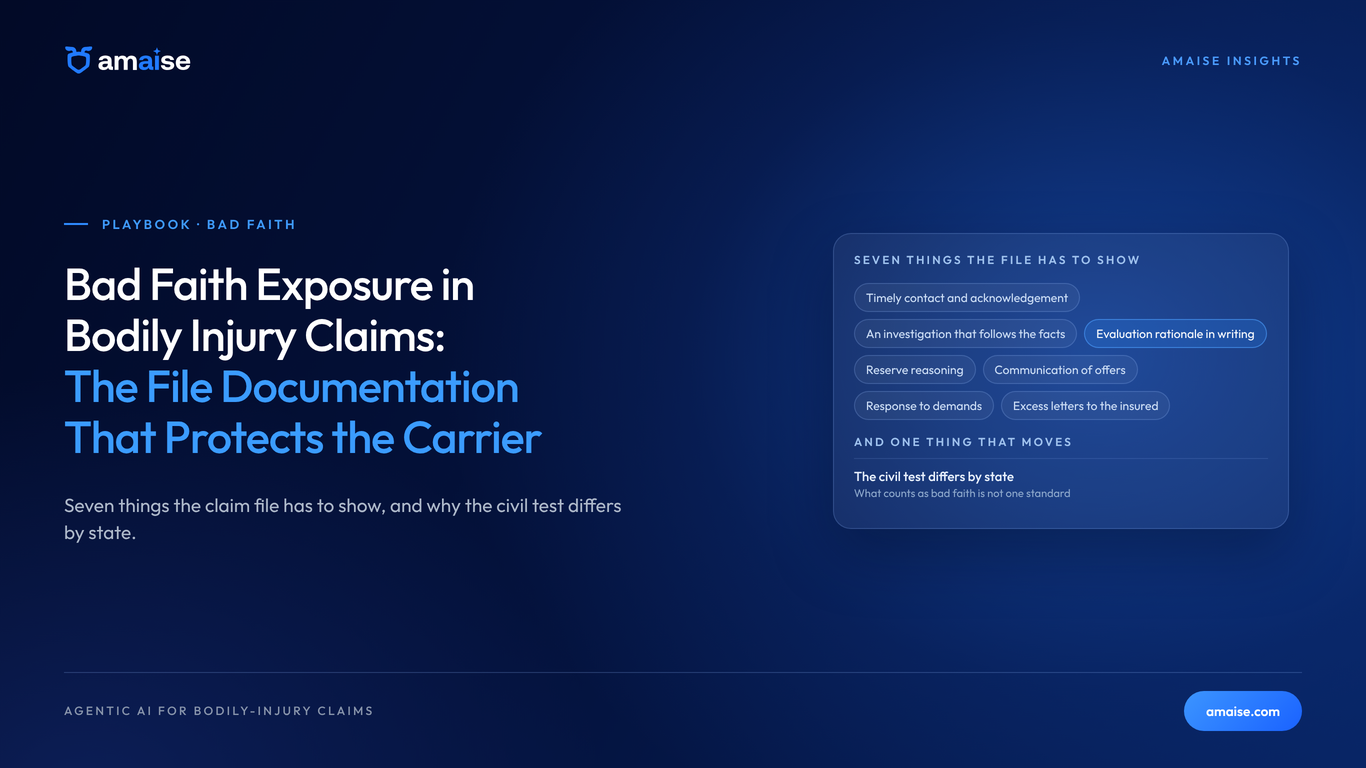
Seven things the claim file has to show, and why the civil test differs by state.
In a bodily injury bad faith case, the claim file often becomes the main witness. This guide sets out what the file should show and how plaintiffs read it in discovery.
Why the claim file decides a bad faith insurance claim
A bad faith insurance claim is rarely decided by the settlement figure alone. It turns on what the claim file shows the carrier knew, did and said, and when.
In bodily injury claims, a common allegation is a failure to settle within limits. A verdict lands above the policy, and the carrier is then asked to answer for the excess.
Nobody in that later case sees the adjuster's intentions. They see the file: diary notes, letters, reserve history, emails and evaluation worksheets.
So the defense to insurance bad faith is mostly built before anyone alleges it. This article covers what the file should show, and how plaintiffs read it.
This is general claims-handling information, not legal advice. Bad faith law varies widely by state, and counsel decides how any specific file is handled.
The standards behind bad faith claims handling
Most state claims-handling rules trace back to two NAIC models. The Unfair Claims Settlement Practices Act (Model 900) lists conduct that regulators treat as unfair. Its companion model regulation, Model 902, turns that list into working standards.
The Model 900 list includes, in summary:
- failing to adopt and implement reasonable standards for the prompt investigation and settlement of claims
- failing to acknowledge pertinent communications with reasonable promptness
- not attempting in good faith to effectuate prompt, fair and equitable settlements where liability has become reasonably clear
- compelling insureds to sue by offering substantially less than the amounts later recovered
- failing to give a reasonable explanation of the basis for a denial or a compromise offer
The model reaches these acts when committed flagrantly and in conscious disregard of the Act. It also reaches them when frequent enough to indicate a general business practice.
Model 902 is where documentation becomes explicit. It expects each relevant document to be noted with the date it was received, processed or mailed. It expects the file to be detailed enough to reconstruct the insurer's activities on the claim. It also sets 15 calendar days to acknowledge a claim notice and to reply to other pertinent communications.
States adopted these models in their own words. California's Insurance Code section 790.03(h) lists failing to "acknowledge and act reasonably promptly upon communications" as an unfair practice. It also lists failing to attempt good-faith settlement once liability has become reasonably clear.
These are regulatory standards. Model 902 states that it creates no private cause of action, and whether a breach supports a civil claim depends on state law. They still describe the conduct a file will be measured against.
The civil test differs by state
Florida's bad faith statute, Fla. Stat. 624.155, was changed by 2023 amendments. One added provision says "mere negligence alone is insufficient to constitute bad faith."
The 2023 amendments also added a 90-day safe harbor for liability claims. No bad faith action lies if the insurer tenders the lesser of the limits or the amount demanded within that window.
The 90 days run from actual notice of a claim accompanied by sufficient evidence to support the amount. Both provisions sit inside a longer statute with other conditions.
Texas applies the Stowers doctrine. In American Physicians Insurance Exchange v. Garcia (1994), the Texas Supreme Court framed it around three conditions (Garcia opinion).
The claim must be within coverage, the demand within limits, and its terms ones an ordinarily prudent insurer would accept. State rules change, so confirm current law with counsel.
Seven things the claim file has to show
The seven elements below are a practical checklist. They draw on the Model 902 documentation standard and the duties described above. Each maps to a question that can come up in a deposition.
1. Timely contact and acknowledgement
The file should show when notice arrived and when the first contact happened. That means the insured, the claimant and any claimant counsel.
Record every contact attempt, including the ones that failed. A note that says "called claimant counsel, left message, follow-up diaried for Friday" shows activity. A two-week gap with no entry does not.
Acknowledgement letters belong in the file with their send dates. Model 902 sets 15 calendar days to acknowledge a claim notice. Many states set a shorter or different period, so measure the file against the applicable state rule.
2. An investigation that follows the facts
Liability and damages both need a visible trail: police reports, statements and photos on one side, medical records, bills and wage documents on the other.
For each records request, log who was asked, when, and when the follow-up went out. Silence while records are outstanding reads as inactivity. A dated note explaining the wait reads as diligence.
The investigation should also show where it changed direction. If a prior injury surfaced, the file should say when and how it was addressed. A dated medical chronology built from the full record makes that sequence easy to show.
3. Evaluation rationale in writing
A number without reasoning is the weakest document in any file. The evaluation should state the liability assessment, the injuries accepted and disputed, and the specials figures relied on.
It should also name the causation questions, any pre-existing conditions, and venue considerations. Express the value as a range, and record who approved it.
Then keep it current. An evaluation written before the MRI arrived, and never revisited, is an easy exhibit. Each new medical record or expert report should trigger a dated note, even if the value does not move.
4. Reserve reasoning
Reserve history is often requested in bad faith discovery. Courts are split on whether reserves are discoverable and on whether they qualify as work product. Many decide case by case, based on the allegations (National Law Review).
Assume the history may be read. Every reserve change should carry a note naming the document or event that triggered it.
The hardest pattern to explain is a reserve near limits beside an offer far below it. If the company's reserving practice explains the gap, the file should say so. The link between early file review and reserve development matters here as well.
5. Communication of offers
Every offer and counter-offer should appear with its date, amount, delivery method and written basis. Model 900 lists failing to explain a compromise offer among its unfair practices.
The insured needs to hear about offers too. In Allstate Insurance Co. v. Miller, 212 P.3d 318 (Nev. 2009), the Nevada Supreme Court addressed this (Miller opinion).
It held that the covenant of good faith includes a duty to adequately inform the insured of settlement offers. Other states frame the duty differently, but the file should show the insured was told.
6. Response to demands
Log each demand's receipt date, deadline and stated terms on the day it arrives. Diary the deadline, and escalate early if records or authority are missing.
The response should go out in writing, before the deadline, and address every stated term, not just the amount. Requests for clarification should also be in writing. The 30-day playbook for time-limited demands covers the day-by-day mechanics.
7. Excess letters to the insured
When exposure may exceed the limits, the file should show the insured was warned in writing. Florida's Supreme Court set out the core duties in Boston Old Colony Insurance Co. v. Gutierrez (1980).
They include advising the insured of settlement opportunities and the probable outcome of the litigation. They also include warning of a possible excess judgment and of steps the insured might take to avoid it (Gutierrez opinion).
What else an excess letter should contain, and when one is required, varies by state. That is a question for coverage counsel.
Timing matters as much as content. A late excess letter weakens the file.
How plaintiffs use the file in insurance bad faith claims
In bad faith litigation, the claim file is a central discovery target. In federal court, discovery reaches any nonprivileged matter relevant to a claim or defense and proportional to the needs of the case (FRCP 26). State discovery rules differ from the federal rule and from each other.
Work product and privilege have limits
Florida offers the best-known example, but it is a first-party example. In Allstate Indemnity Co. v. Ruiz (2005), the insured was suing its own insurer.
The Florida Supreme Court held that claim file work product is discoverable in first-party bad faith actions (Florida Supreme Court opinion). It reasoned that the file is often the only direct evidence of how the claim was handled.
Genovese v. Provident Life & Accident Insurance Co., 74 So. 3d 1064 (Fla. 2011), then drew a line. Attorney-client privileged communications stay protected in first-party bad faith actions (Hinshaw & Culbertson summary).
Third-party failure-to-settle claims, the usual bodily injury case, follow their own discovery rules. Those vary by state and by court, so counsel should confirm what applies.
In federal court, FRCP 26(b)(3) protects material prepared in anticipation of litigation, with added protection for attorney mental impressions. Routine adjusting work may fall outside that line. Anything withheld must be described in a privilege log.
Electronic records and timestamps
Plaintiffs also request emails, internal chats and claim system audit trails, all electronically stored information (ESI).
In federal court, FRCP 37(e) lets a judge order curative measures when ESI that should have been preserved is lost. The harshest sanctions, such as an adverse inference instruction, require a finding of intent to deprive. State spoliation rules differ.
Timestamps work both ways. Under Federal Rule of Evidence 803(6), a record made at or near the time in the regular course of business can be a business record. Its foundation still has to be laid.
Courts also weigh when and how a note was entered. A note added weeks later, revealed by the audit trail, invites the question of what it was written to explain.
What a timeline exposes
A timeline built from notes, letters, emails and audit trails tends to expose these patterns:
- gaps in activity while a demand or deadline was pending
- an evaluation that was never updated after new medical evidence arrived
- reserve changes with no stated reason
- offers with no written basis, or offers that ignore the file's own evaluation
- a demand deadline that passed before a response went out
- a late, missing or generic excess letter
- notes that contradict the letters sent to the claimant or insured
- entries added long after the events they describe
Each is a documentation failure, and most can be prevented on the day the work is done.
A hypothetical file, read as a timeline
Consider an illustrative auto liability file, not a real case. The evaluation was written in month two, before the MRI report arrived.
Claimant counsel then sent a policy limits demand with a 30-day deadline. The MRI report came in on day 12, and no note followed.
The file changed hands on day 20. The written response went out on day 34, after the deadline. The excess letter followed a week later.
As a timeline, that file shows a stale evaluation, a silent gap, a missed deadline and a late warning to the insured. None of it required bad intent.
A documentation check for every bodily injury file
- Contact and acknowledgement. What supports the carrier: Dated notes of every attempt, prompt written acknowledgement. What a plaintiff exploits: Unexplained silence after notice.
- Investigation. What supports the carrier: Dated requests and follow-ups for each record. What a plaintiff exploits: Records requested late or never chased.
- Evaluation. What supports the carrier: Written range with reasoning, updated on new evidence. What a plaintiff exploits: A stale number with no rationale.
- Reserves. What supports the carrier: A note tied to each change. What a plaintiff exploits: Reserve near limits, offer far below, no explanation.
- Offers. What supports the carrier: Date, amount, basis, delivery proof, insured informed. What a plaintiff exploits: Unexplained offers, insured kept in the dark.
- Demands. What supports the carrier: Deadline diaried, written response to every term. What a plaintiff exploits: Missed deadline, terms ignored.
- Excess letter. What supports the carrier: Sent early, updated as exposure grows. What a plaintiff exploits: Sent late, generic or missing.
Where the record usually breaks
A thin file is often the product of ordinary pressure, not intent. Files change hands, and the new adjuster inherits notes written in shorthand. Records arrive in pieces over months. Important context sits in email rather than the claim system. On a heavy desk, the evaluation update waits for a quieter week that never comes.
Long files make this harder. A 400-page file can hide the record that changes the value. If nobody found it, the file cannot show it was considered.
This is where structured file review helps. Bodily injury claim file review tools such as amaise process the unstructured documents in an injury file and organize the medical records. Each extracted finding links back to its source page. The adjuster still writes the evaluation and makes the call.
Frequently asked questions about insurance bad faith claims
Is the claim file discoverable in a bad faith case?
It depends on the state and on whether the claim is first-party or third-party. In Florida first-party actions, Ruiz (2005) made claim file work product discoverable. Genovese (2011) kept attorney-client privilege intact. Ask counsel what applies.
Are reserves discoverable?
Courts are split, and many decide case by case based on the allegations.
What should an excess letter include?
Courts look for a timely warning. Florida's Gutierrez decision lists advising of settlement opportunities and the probable outcome, and warning of a possible excess judgment. Requirements vary by state, so ask counsel.
Does breaking an unfair claims practices rule create a lawsuit?
Not automatically. NAIC Model 902 states that it creates no private cause of action. Whether a violation supports a civil claim depends on each state's statutes and case law.
The file is the defense
The carrier's best protection against a bad faith insurance claim is a file that explains itself. It shows prompt contact, a real investigation, written reasoning, explained reserves, communicated offers, answered demands and timely excess letters. Every entry is made when the work happens, not reconstructed after a verdict.
Key takeaways
- A badaith insurance claim usually turns on the claim file, so the defense is the record made while the claim was handled.
- NAIC Model 900 lists unfair claims practices, and Model 902 expects a dated file detailed enough to reconstruct the insurer's activities.
- A practical checklist: timely contact, investigation, evaluation rationale, reserve reasoning, communicated offers, answered demands and timely excess letters.
- Discovery rules differ for first-party and third-party claims and by state; Florida's Ruiz and Genovese decisions are first-party cases.
- This is general information, not legal advice; confirm current state law with counsel.