Blog
novembre 4, 2026

par
Andrej Evtimov
Who has a claim on the settlement, and what to request before you agree a number.
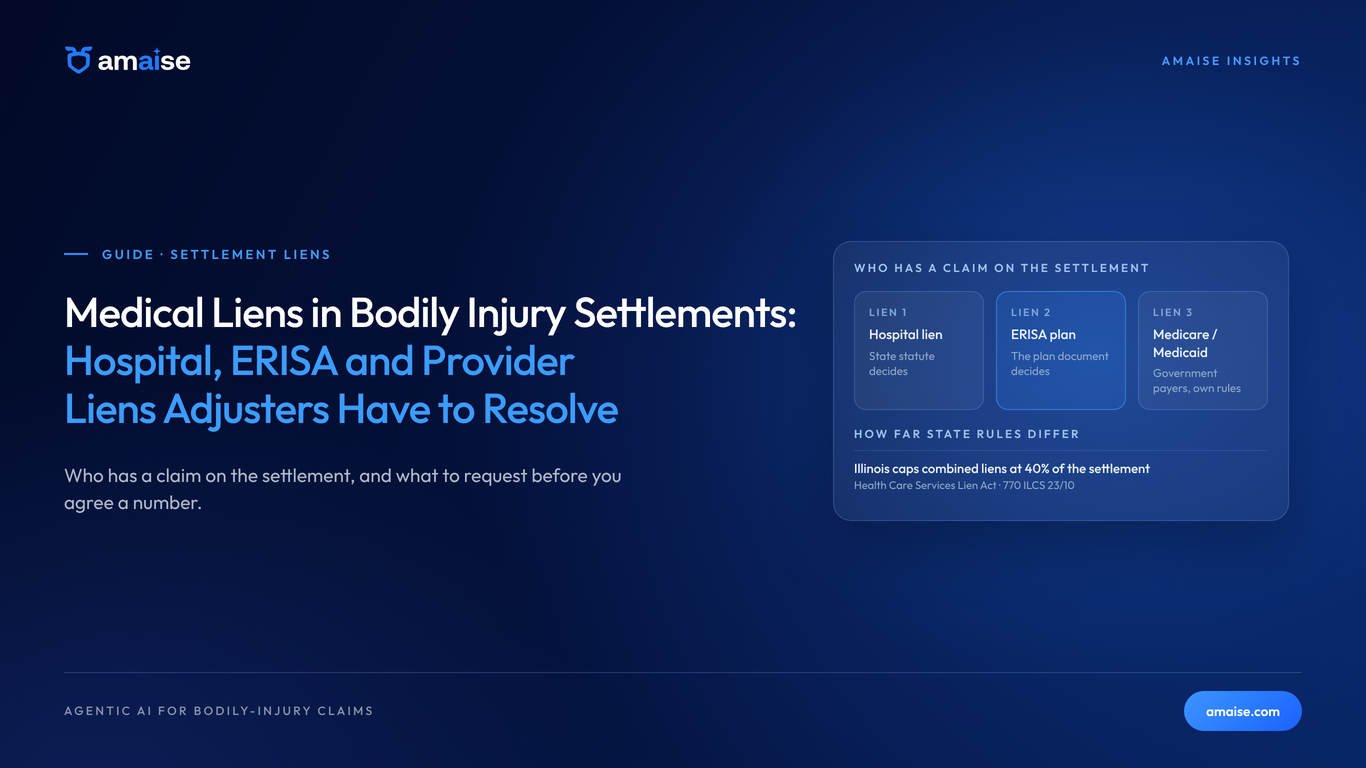
A bodily injury settlement can carry several medical liens at once, each from a different body of law. This article explains hospital, ERISA, Medicare, Medicaid and provider liens, and what the adjuster must resolve before release and payment.
Medical lien basics: who has a claim on the settlement
A medical lien is a legal claim against an injured person's recovery by someone who paid for, or provided, that person's treatment. Several can attach to one bodily injury settlement, each from a different body of law.
The settlement amount is not the amount the claimant keeps. Part of it may be owed to a hospital, a health plan, Medicare, Medicaid or a provider. Where a lienholder has rights against the payer, a missed lien can mean paying for the same treatment twice.
- Hospital. Where the right usually comes from: State hospital lien statute. Where the carrier's exposure usually sits: Can be direct: some statutes limit the effect of a release that ignores a perfected lien.
- Employer health plan (ERISA). Where the right usually comes from: Plan reimbursement or subrogation terms. Where the carrier's exposure usually sits: Mainly through the claimant and the settlement money, under the plan's terms.
- Medicare. Where the right usually comes from: Federal Medicare Secondary Payer rules. Where the carrier's exposure usually sits: Direct: the regulation lets Medicare recover from the primary payer.
- Medicaid. Where the right usually comes from: Federal Medicaid Act, administered by the state. Where the carrier's exposure usually sits: Mainly the part of the recovery allocated to medical care, under state procedure.
- Treating provider. Where the right usually comes from: Letter of protection or other contract. Where the carrier's exposure usually sits: Mainly the claimant's agreement with the provider, which also shapes the damages evidence.
The exposure column is a starting point, not a rule, and state law, plan terms and release wording can shift it. This article is general information, not legal advice. Counsel should review the position on any specific file.
What is a hospital lien?
A hospital lien is a statutory right that lets a hospital claim part of an injured patient's recovery from a liable third party. It attaches to the claim or its proceeds, not only to the patient. That is why it can matter to the carrier, not just to the claimant's lawyer.
Many states have a hospital lien statute, and the details differ widely. Most are built from the same few parts.
- Scope. Which services, patients and providers the lien covers.
- Perfection. The hospital usually has to file or serve a notice before the lien is enforceable.
- Limits. Caps, or a tie to reasonable charges.
- Effect on release. What happens when a settlement is paid without satisfying the lien. This is the part that reaches the carrier.
Two examples of how far the rules differ
Texas sets out its hospital lien in Chapter 55 of the Property Code. A hospital secures the lien by filing a written notice with the county clerk. The notice names the injured person, the accident date and the person alleged to be liable (Texas Property Code ch. 55).
Section 55.007 then addresses validity of release. A release of a claim the lien attaches to is not valid unless one of three conditions is met (Tex. Prop. Code 55.007):
- the hospital's charges were paid in full before the release was executed and delivered;
- the charges were paid before delivery, up to the settlement money the injured person received from the other parties; or
- the hospital is itself a party to the release.
Commentary on the statute reads the result as an invalid release, with the lien on the claimant's cause of action still in effect (Mondaq). So a Texas lien notice is a payment question, not only a claimant question. This summary is partial, and Chapter 55 has further notice and amount rules.
Illinois takes a different approach. Its Health Care Services Lien Act covers health care professionals and providers, not only hospitals. It caps the combined liens under the Act at 40% of the verdict, judgment, award, settlement or compromise (770 ILCS 23/10). When liens reach that level, the statute splits the capped amount between professionals and providers. It also limits attorney liens in that situation.
Texas focuses on whether the release survives, Illinois on how much lienholders can take in total. A national operation needs a current state-by-state view. Both statutes have been amended over time, so confirm current law with counsel.
ERISA lien rules: the plan document decides
An ERISA lien is a reimbursement claim by an employer-sponsored health plan that paid the claimant's accident-related medical bills. ERISA is the federal statute governing most private employer benefit plans. These claims can be among the larger amounts on a moderate injury file. Self-funded plans follow federal ERISA rules and plan terms. Insured plans can also be subject to state insurance law.
Self-funded or insured: the first question to answer
In FMC Corp. v. Holliday (1990), the Supreme Court held that ERISA preempted a Pennsylvania anti-subrogation law as applied to a self-funded plan. The deemer clause kept the state insurance law from reaching that plan (FMC Corp. v. Holliday, Cornell LII). State anti-subrogation and made-whole rules can still affect insured plans through regulation of the insurer. So the same claim can be negotiable under state law in one file and governed only by plan terms in another.
Three Supreme Court cases adjusters should recognize
Sereboff v. Mid Atlantic Medical Services (2006). The plan sued the beneficiaries who had received a tort settlement. The Court treated the suit as one for an equitable lien by agreement. The plan identified a particular fund and its share, so the relief was "equitable" under ERISA section 502(a)(3) (Sereboff, Cornell LII).
US Airways v. McCutchen (2013). The Court held that equitable doctrines such as the common-fund rule and the double-recovery rule cannot override a plan's clear reimbursement terms. Where the plan is silent on allocating attorney's fees, the common-fund doctrine fills the gap (US Airways v. McCutchen, 569 U.S. 88). Plan wording on fees therefore shapes the net lien amount.
Montanile v. Board of Trustees (2016). The Court ruled 8-1 that a plan cannot reach a participant's general assets once the settlement fund is spent on nontraceable items. In the Court's words, spending the entire identifiable fund "on nontraceable items (like food or travel) destroys an equitable lien" (Montanile opinion, Justia).
In each case, the plan pursued the participant or the settlement money, not the liability carrier. Montanile explains why plans move fast once they learn of a settlement, which puts pressure on timing and release terms. Whether a plan has any claim against the paying carrier is a question for counsel.
What to request for an ERISA lien
- The governing plan document, not only a summary or a recovery vendor's letter.
- Confirmation of whether the plan is self-funded or insured.
- An itemized payment ledger with dates of service, providers and diagnosis codes.
- The plan's position on attorney's fees and any reduction request.
The itemized ledger is where many disputes sit. A plan ledger can include a prior back condition, a routine physical or an unrelated prescription.
Medicare and Medicaid: government payers with their own rules
Medicare conditional payments
Medicare pays some accident-related bills conditionally and then seeks repayment. Under 42 CFR 411.24(i)(1), where Medicare has not been reimbursed as the regulation requires, the carrier's exposure is direct. The primary payer "must reimburse Medicare even though it has already reimbursed the beneficiary or other party" (42 CFR 411.24, GovInfo).
CMS describes the Conditional Payment Letter amount as interim. It recommends reporting a settlement to the recovery contractor so it can identify related claims paid since the last letter (CMS, Conditional Payment Information). Reporting duties are covered in a separate post on Medicare conditional payments in BI settlements. Recovery by Medicare Advantage and Part D plans is outside the scope of this article.
Medicaid: Ahlborn, Wos and Gallardo
Medicaid recovery runs through the state agency, but federal law sets its limits. The Supreme Court's 2022 Gallardo opinion summarizes the line of cases (Gallardo v. Marstiller, Justia).
- Arkansas DHHS v. Ahlborn (2006). The federal anti-lien provision bars a state from taking any part of a settlement not designated as payment for medical care.
- Wos v. E.M.A. (2013). A state cannot impose an irrebuttable, statutory allocation of a settlement to medical expenses.
- Gallardo v. Marstiller (2022). A state may seek reimbursement from the portion of a settlement allocated to medical care, including future medical care. The Court framed the line as "between medical and nonmedical expenses."
When the claimant is a Medicaid recipient, allocation language matters. The agency's notice, its itemized claim and any release allocation belong in the file before payment.
Provider claims and letters of protection
A treating provider's claim is often contractual rather than a statutory lien. The usual form is a letter of protection, under which a provider treats now and is paid from the settlement later. Florida describes it as an arrangement where a provider treats "in exchange for a promise of payment" from a judgment or settlement (Fla. Stat. 768.0427).
Florida added section 768.0427 in 2023. In the personal injury and wrongful death actions it covers, it requires disclosures where a letter of protection is involved. These include the letter, coded itemized bills and any price a factoring company paid. Georgia's 2025 tort reform, Senate Bill 68, made letter of protection agreements relevant and discoverable. The same applies to amounts of receivables sold to third parties (Shook, Hardy & Bacon). These rules are recent, so confirm current law with counsel.
Two questions matter. Who holds the receivable now, the provider or a funding company? And is the amount a chargemaster rate no payer would actually pay? The billing side is covered in a separate post on soft tissue claims, letters of protection and billed vs paid.
Hospital lien and ERISA lien checklist before release and payment
Lien work often fails at the end of the file because it starts too late. This general sequence should be adapted to state law and counsel's advice.
- Identify payers. What to obtain: ER face sheet, health plan cards, explanations of benefits, Medicare and Medicaid status. Why it matters: The face sheet often names the payer before anyone asserts a lien.
- Log every notice. What to obtain: Hospital lien notices, plan recovery letters, state Medicaid notices, letters of protection. Why it matters: Each has its own deadline and recipient.
- Check perfection. What to obtain: Filing or service required by the state statute. Why it matters: An unperfected lien may be handled differently, which counsel should confirm.
- Audit relatedness. What to obtain: Itemized ledgers matched to dates of service and diagnoses. Why it matters: Unrelated charges are a basis to ask for a reduction.
- Confirm final amounts. What to obtain: Written final demand or payoff from each lienholder. Why it matters: Interim figures change after settlement.
- Draft the release. What to obtain: Lien satisfaction and indemnity terms, with allocation where relevant. Why it matters: Indemnity helps, but it does not erase a statute or federal recovery right.
- Pay with proof. What to obtain: Direct payment or lienholder as co-payee, where appropriate. Why it matters: The file should show each lien was satisfied or released.
Delay carries its own risk. Lien handling should not become the reason a reasonable offer stalls.
An illustrative file
Picture a hypothetical Texas auto liability claim, built for illustration only. The claimant went to the ER, then saw a chiropractor under a letter of protection. A self-funded employer plan paid other bills.
The ER face sheet names the plan, and the county clerk's records show a hospital lien notice. The adjuster asks for the plan document and confirms the funding status. A routine physical and an earlier back visit on the plan ledger go back as unrelated. Before release, the hospital, the plan and the chiropractor each confirm final amounts in writing. The hospital joins the release, meeting one Texas condition, and counsel approves the wording.
Where lien resolution breaks down in a long file
Many lien disputes come down to relatedness. Plan ledgers, hospital bills and Medicaid claims list services by date and code. Each line has to be matched to accident-related treatment in the records.
That match depends on a reliable timeline. A medical chronology built from the full claim file shows which visits relate to the injury, which predate it and which treat something else. Without it, the adjuster accepts the ledger as presented or argues from memory.
For bodily injury claim file review, amaise categorizes the medical records in the file, and its platform keeps findings traceable to the source documents. The adjuster still decides which charges are related and what to pay.
Common questions about medical liens
Does it matter whether an ERISA plan is self-funded or insured?
Yes. In FMC Corp. v. Holliday (1990), ERISA preempted a state anti-subrogation law as applied to a self-funded plan (Cornell LII). State insurance law can still reach insured plans through regulation of the insurer. The same reimbursement claim may therefore follow different rules.
Can an ERISA plan recover after the settlement money is spent?
Generally not from the participant's general assets. Under Montanile (2016), spending the identifiable fund on nontraceable items defeats the plan's equitable lien (Justia). Plans therefore tend to assert reimbursement early.
Does an indemnity clause in the release protect the carrier from liens?
Only partly. It shifts risk back to the claimant on paper. It does not stop Medicare from recovering from the primary payer under 42 CFR 411.24. It also may not save a release that a state statute treats as invalid, as in Texas. Counsel should review the release on each file.
Every medical lien in a bodily injury settlement has an owner, a legal basis and a deadline. Identify each early, audit it against the records, and close it in writing before payment.
Key takeaways
- A medical lien is a claim on the settlement by whoever paid for or provided the claimant's treatment.
- A hospital lien comes from state statute, and in some states a release that ignores it is not valid.
- An ERISA plan's recovery turns on plan wording and funding status, and it usually runs against the claimant and the settlement money.
- Medicare can recover from the primary payer even after the claimant has been paid.
- Identify every lienholder early, audit each ledger against the medical chronology, and close each lien in writing before payment.