Blog
October 6, 2026

by
Andrej Evtimov
Patterns you can check against documents already in the file, without an expert.
A medical specials package usually reaches a liability claim file without ever passing through a payer's edit engine. These six billing patterns can be checked against documents that are already in the file.
Nobody adjudicated these bills before they reached your desk
A medical specials package arrives as a stack of CMS-1500 and UB-04 forms behind a demand letter. It looks official. It is not adjudicated.
Medicare claims pass through automated screens before payment. CMS runs procedure-to-procedure (PTP) edits, which it calls "automated prepayment edits that prevent improper payment when you report certain codes together." It also runs Medically Unlikely Edits (MUEs). Those cap the units of one code billed for one patient on one day (CMS, How to Use the Medicare NCCI). A group health claim passes through a payer's own edit engine and a negotiated fee schedule.
Many liability specials pass through none of that. Charges billed under a letter of protection, or by a provider treating on a lien, reach the file unadjudicated. The provider set the charge, chose the code and totaled the page. The plaintiff's firm assembled it. The first person to check the arithmetic is the adjuster.
Two exceptions are worth noting. Where the claimant had health coverage that paid or adjusted a bill, an edit engine did see it. Workers' compensation bills run through a state fee schedule and formal bill review. The unscreened charges are the ones to sort out first.
Coding integrity is a separate question from treatment reasonableness. The soft tissue argument asks whether the care was necessary. This one asks whether the bill describes the care that actually happened. The second argument can be raised on documents already in the file, without an expert and without a medical opinion.
One framing point before the patterns. The Medicare rules cited below do not govern a liability bill. They are the most detailed public coding standard available, so they work as a yardstick for what a code is supposed to mean. Whether a charge is reasonable, and what a jury hears about it, is set by the law of the venue.
Below are six patterns worth a pass on every package over a threshold the unit sets. Each one shows what it looks like on the page. The bill lines and notes in the examples are illustrative. They are composites written for this article, not extracts from a real file.
- 1. Same service on two bills. Documents to compare: UB-04 and CMS-1500 for one date. Signal on the page: Identical CPT code, no 26 or TC modifier.
- 2. Code does not fit the visit (upcoding). Documents to compare: Bill line and chart note. Signal on the page: High-level E/M code, thin note.
- 3. Visits inside the global surgical period. Documents to compare: Surgical date and later office visits. Signal on the page: Post-op visit billed by the operating surgeon.
- 4. Facility fee on an office visit. Documents to compare: Physician bill and hospital bill. Signal on the page: G0463 or a facility line on a clinic date.
- 5. Charges after treatment ended. Documents to compare: Discharge summary and ledger. Signal on the page: Dates of service past the last encounter.
- 6. Modifiers 25 and 59. Documents to compare: Bill line and chart note. Signal on the page: Modifier present, separate work absent.
Pattern 1: The same service on two bills
Imaging and hospital-based procedures split into two parts. The technical component covers the equipment, the room and the staff. The professional component covers the physician who reads the study and writes the report. Two entities bill, and both bills are legitimate.
The error is the missing split. The hospital bills the global code. The reading group bills the same global code. Nothing on either form says the charge covers only half the service.
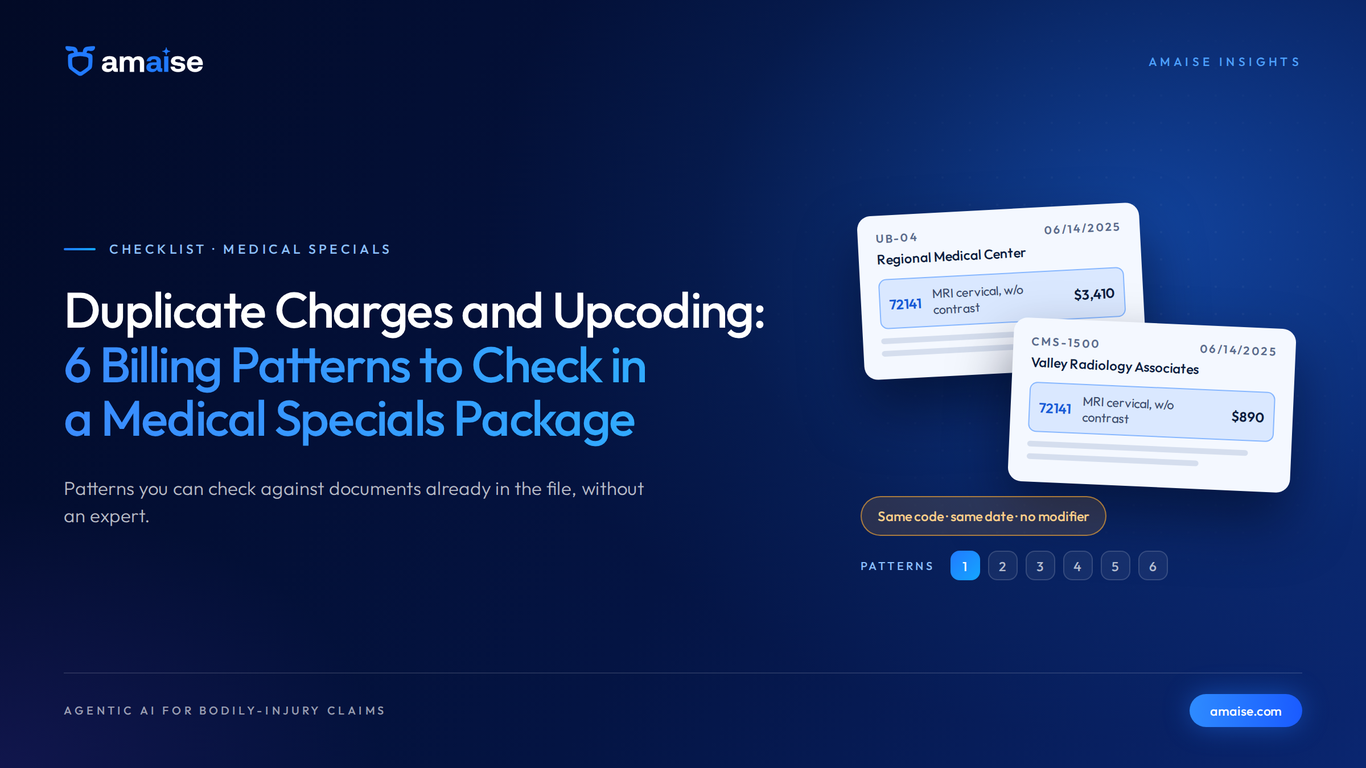
Example: one MRI, two global charges
UB-04 | Regional Medical Center
06/14/2025 · 72141 · MRI cervical spine, w/o contrast · $3,410.00
CMS-1500 | Valley Radiology Associates
06/14/2025 · 72141 · MRI cervical spine, w/o contrast · $890.00
Same date. Same code. No modifier on either line. Billed correctly, the hospital line carries modifier TC and the radiology line carries modifier 26.
Check every imaging study, every ER visit and every ambulatory surgery date against the full package. Two other sources of genuine duplicates are worth a look. A practice that changed tax IDs mid-treatment may have rebilled the earlier dates. A records custodian may have produced the same ledger twice under two cover sheets. Match on date of service plus CPT code, not on provider name.
Pattern 2: A code that does not fit the documented visit
Office and outpatient evaluation and management (E/M) codes run from a brief check to a high-complexity encounter. The level depends on medical decision making or on total time. The chart note is the proof.
Billing a higher-level code than the visit supports is called upcoding. It is one of the most audited coding problems in US healthcare. The HHS Office of Inspector General found that Medicare inappropriately paid $6.7 billion for E/M claims in 2010. Those claims were incorrectly coded, lacked documentation, or both. That was 21 percent of Medicare E/M payments that year (OIG, OEI-04-10-00181).
The pattern has not gone away. A 2025 OIG audit of podiatry E/M claims found that 44 of 100 sampled claims did not comply with Medicare requirements. OIG projected roughly $39.6 million in improper payments out of $222.5 million Medicare paid for those services (OIG, A-09-22-03012).
Example: a high-level code against a three-line note
Bill line
09/02/2025 · 99215 · Office visit, established patient, high level · $425.00
Chart note, same date
"Pt reports neck pain improving. ROM improved since last visit. Continue home exercise program. RTC 4 weeks."
A three-line note describing improvement and a continued home program does not carry a high-level code. Pull the note for every visit coded 99214 or 99215 and read the assessment and plan. You are not second-guessing the clinician's care. You are comparing the code on the bill to the words in the record.
The same test applies to therapy units. Timed physical therapy codes are billed in 15-minute units. If the daily note records a 30-minute session and the bill shows six units, the two documents disagree.
Pattern 3: Follow-up visits billed inside the global surgical period
Surgical CPT codes carry a global period of 0, 10 or 90 days. Routine post-operative care falls inside the fee already billed for the surgery. The CMS coding manual is direct. It states that "the global surgical package includes all medical and surgical services required of the surgeon during the postoperative period." That covers treating complications that do not require a return to the operating room (CMS, Medicare NCCI Policy Manual 2026, Chapter 1).
Example: two post-op checks inside a 90-day window
07/12/2025 · 63030 · Laminotomy, lumbar, single interspace · $18,750.00
(90-day global period)
08/05/2025 · 99213 · Office visit, established patient · $180.00
08/28/2025 · 99213 · Office visit, established patient · $180.00
Two routine post-op checks inside the 90-day window, billed separately by the operating surgeon. Individually small. Across a surgical file with several procedures, the total moves.
Build the treatment timeline first, then lay the surgical dates and their global periods over it. Any office visit by the operating surgeon inside that window needs a reason in the note that goes beyond routine recovery.
Pattern 4: A facility fee attached to an office visit
A hospital system buys a physician practice. The office does not move, the staff does not change, and the sign on the door may not change. The billing does. The clinic is now a provider-based department. One visit produces two bills: a professional fee from the physician and a facility fee from the hospital.
The gap is large enough to drive behavior. The Medicare Payment Advisory Commission tracked chemotherapy administration from 2015 to 2021. Volume in freestanding clinician offices fell 14.2 percent. Volume in hospital outpatient departments climbed 21.0 percent. MedPAC modeled aligning outpatient rates with physician fee schedule rates for 66 service groups. That change would have cut 2021 Medicare outpatient outlays by $6.0 billion (MedPAC, June 2023 Report to Congress, Chapter 8).
Example: a clinic visit that produces two bills
CMS-1500 | Orthopedic Associates (provider-based clinic)
10/08/2025 · 99214 · Office visit, established patient · $265.00
UB-04 | Regional Medical Center
10/08/2025 · G0463 · Hospital outpatient clinic visit · $498.00
The second bill is not necessarily improper. Provider-based billing is lawful, and in Medicare it is regulated. In a liability claim it is neither adjudicated nor discounted, so a routine follow-up can carry a hospital charge on top of the physician charge.
Legislatures are moving on this. In 2025, eleven states considered facility fee bills and three enacted them. Indiana's law bars a provider in an office setting from billing with hospital place-of-service codes (MultiState, September 2025). Check the rule in the treatment state before you argue the line. A charge that is prohibited in the treatment state is a stronger objection than a charge you simply find high.
Pattern 5: Charges dated after treatment ended
Date-of-service errors are the easiest pattern to find and easy to miss. Finding them means reading two documents against each other, not reading one document closely.
The federal programs audit for this routinely, and the historical figures show the scale. OIG has examined claims dated after a beneficiary's death more than once. In 2011, Medicare inappropriately paid $23 million on such claims (OIG, OEI-04-12-00130). Liability files have a softer version of the same test: the last documented encounter.
Example: three charges after a documented discharge
Discharge summary, Valley Physical Therapy
"Patient discharged from PT 10/31/2025, goals met, no further visits scheduled."
Ledger, same provider
11/04/2025 · 97110 · Therapeutic exercise, 2 units · $220.00
11/07/2025 · 97110 · Therapeutic exercise, 2 units · $220.00
11/12/2025 · 97140 · Manual therapy, 1 unit · $130.00
Three charges after a documented discharge. Four other date tests are worth running on every package:
- Charges on a date the claimant was admitted somewhere else, or was out of state.
- Charges dated before the loss date, which usually means prior treatment was swept into the package.
- A block of identical charges on consecutive dates with no matching daily notes.
- A final bill dated after the demand letter it supports.
Pattern 6: Modifiers 25 and 59 used to open a closed door
Two modifiers exist to tell a payer that a bundling rule should not apply. Modifier 25 marks an E/M service as significant and separately identifiable from a procedure performed the same day. Modifier 59 marks a distinct procedural service. Both are legitimate. Both are also the usual route by which an edit gets bypassed.
The CMS manual sets the condition plainly. These modifiers "should not be used to bypass a PTP edit unless the proper criteria for use of the modifier are met." The manual adds that the medical record must satisfy the criteria for the modifier used (CMS, Medicare NCCI Policy Manual 2026, Chapter 1).
The scale of the gap is documented. In a May 2025 audit, OIG examined E/M services billed with modifier 25 on the same day as intravitreal eye injections. Providers billed a same-day E/M service for 42 percent of injections in the audit period, and Medicare paid $124 million for those services. Of 24 sampled services, documentation did not support the modifier for 22 (OIG, A-09-23-03014).
Example: modifier 25 with no separate work in the note
05/19/2025 · 20610-RT · Arthrocentesis, major joint, right knee · $385.00
05/19/2025 · 99213-25 · Office visit, established patient · $180.00
Chart note, same date
"Follow-up right knee effusion. Aspiration performed as discussed at prior visit. Tolerated well. RTC prn."
The note describes the aspiration and nothing else. There is no separate problem evaluated, no separate history, no separate plan. The modifier is on the bill. The work it claims is not in the record.
Modifier 25 on a high proportion of a provider's procedure dates is a pattern, not an event. Count it across the provider, not per line.
Work the package in one order
The patterns overlap, so the sequence matters more than the checklist.
- Build the ledger. Put every charge into one table, one row per line item, across all providers. The columns that matter: date of service (duplicate and post-discharge tests); provider and tax ID (catches rebilling after an ownership change); CPT or HCPCS code (the duplicate match key, with the date); modifier (26, TC, 24, 25, 59); units (therapy and injection quantity tests); and charge (the running total by pattern).
- Sort by date, then by code. Exact duplicates surface immediately. Near-duplicates under two provider names surface next.
- Lay the treatment timeline over it. First visit, surgical dates and their global periods, discharge dates, last documented encounter. Anything outside those boundaries is a date question.
- Pull notes for the high-level codes only. Every 99214, 99215, and every line carrying modifier 25 or 59. This is where reading time pays.
- Total by pattern, not by provider. The demand argues one number. Your response should show which part of that number is a coding question and which part is a treatment question.
- Write objections as document comparisons. "The 08/05 visit falls within the 90-day global period for the 07/12 procedure" travels further than "these charges appear excessive."
Steps 1 through 3 are mechanical. On a file of several hundred pages they are also slow. That is why they get skipped below a severity threshold. Building the ledger and the timeline is document work, which is what AI tools for bodily injury claim file review are aimed at. The condition is provenance: every extracted line must link back to the page it came from, so the adjuster verifies before objecting.
What this changes about the number you defend
A specials total is an argument, not a fact. It sets the anchor for negotiation. In jurisdictions that admit billed charges, it also shapes what the jury hears.
Attacking the total as a whole invites a fight about reasonableness. Attacking six specific patterns is a different conversation, because each objection rests on a document already in the file. A duplicate line is a duplicate of another line in the same package. A post-op visit sits inside a global period the surgical code already covers. A post-discharge charge contradicts the provider's own discharge summary.
That work sits alongside the treatment argument, not inside it. Whether the care was reasonable is a medical question. It turns on the records, as in letters of protection and billed versus paid in soft tissue claims. Whether the bill describes that care accurately is a documents question. It turns on arithmetic.
On auto liability claim files, the second question is usually the faster one to answer. The adjuster who answers it first negotiates from a number they can defend line by line.
Key takeaways
- Many liability medical bills arrive unadjudicated. No edit engine and no fee schedule has screened them before the demand lands.
- Six patterns are worth a pass on every large package: the same service on two bills, a code that does not fit the documented visit, visits inside a global surgical period, a facility fee on an office visit, charges dated after treatment ended, and modifiers 25 and 59 used to bypass a bundling rule.
- Medicare coding rules do not govern a liability bill. They are the most detailed public standard for what a code means, so they work as a yardstick while the law of the venue sets reasonableness.
- Build the charge ledger and the treatment timeline first. Duplicates and date errors surface from sorting; only high-level codes and modifier lines need the chart notes pulled.
- Coding objections travel further than a general reasonableness argument, because each one is a comparison of two documents already in the file.