Blog
November 4, 2026

by
Andrej Evtimov
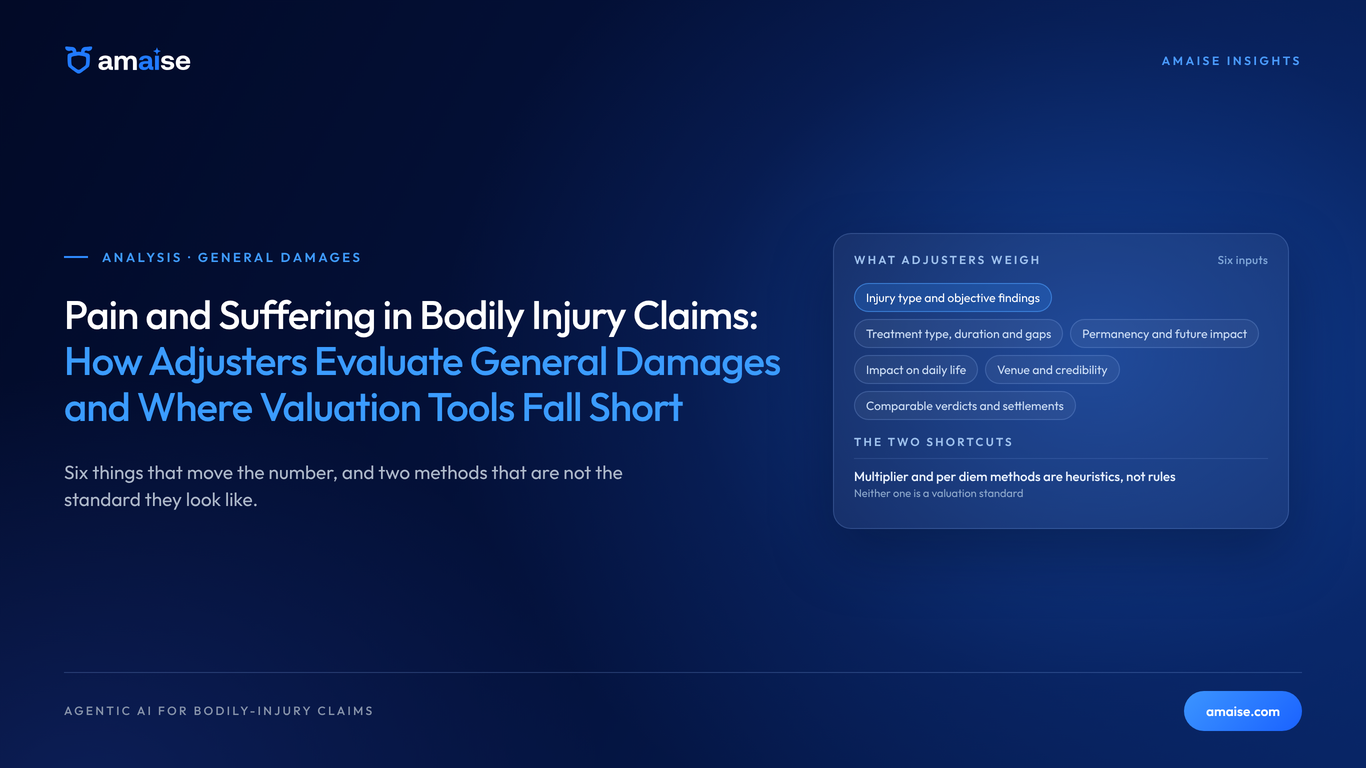
Six things that move the number, and two methods that are not the standard they look like.
General damages have no invoice, so adjusters value pain and suffering from evidence, judgment and a few heuristics. This guide covers the factors that matter, how tools like Colossus work, and where they miss what the file shows.
How is pain and suffering calculated? Start with the two kinds of damages
How is pain and suffering calculated in a bodily injury claim? No universal formula produces the number. Adjusters build it from evidence, judgment and a few rough heuristics. This guide covers US practice and uses California as the worked example. The first step is to separate the two kinds of compensatory damages.
Special damages are the losses with a receipt attached. Medical bills, lost wages and other out-of-pocket costs can be added up and checked against records. General damages cover the losses with no invoice: physical pain, emotional distress, inconvenience and loss of enjoyment of life. Cornell Law School's Wex entry on general damages treats them as a category separate from consequential, or special, damages.
The two halves are evaluated in different ways. Specials are an audit problem. Is each charge related, reasonable and supported, and is the billed or the paid amount the right measure? The post on letters of protection, treatment stacking and billed versus paid covers that work.
General damages are a judgment problem. California's civil jury instruction on noneconomic damages, CACI No. 3905A, tells jurors that no fixed standard exists for deciding the amount. Jurors are asked to reach a reasonable figure from the evidence and their common sense. An adjuster evaluating general damages is predicting what that reasoning would produce for this claimant, in this venue, on this record.
The amounts at stake are large. The Insurance Research Council's auto injury study covers claims closed between mid-2017 and mid-2022. Over that period, the IRC reported that the average auto bodily injury payment rose from about $14,000 to more than $20,000. General damages sit inside that figure, and they are the hardest part of it to audit.
What adjusters weigh when they evaluate general damages
Experienced adjusters look at the same core factors, with or without software. Each factor should trace back to a page in the file.
Injury type and objective findings
A fracture seen on imaging, a surgical repair or a documented nerve deficit carries more weight than a complaint with no objective correlate. Imaging needs careful reading. A 2015 systematic review in AJNR found degenerative spine findings in high proportions of people without symptoms, rising with age. The post on reading the MRI report for acute or degenerative findings covers that distinction.
Treatment type, duration and gaps
Treatment shows how the injury was experienced over time. An emergency visit followed by eight weeks of physical therapy reads differently from injections, a surgical consult and a fusion. Duration matters, and so does continuity. A long gap in care, or a restart soon after counsel is retained, raises questions the record has to answer. A medical chronology built from the full claim file is what makes those gaps visible.
Permanency and future impact
A documented permanent impairment, a surgeon's opinion on future care or a stated work restriction changes the value of general damages. Age can matter as well, since a younger claimant may live longer with a permanent condition. These opinions are often contested, and an independent medical examination is one common way to test them.
Impact on daily life
Loss of enjoyment of life is usually proven with ordinary facts. The claimant stopped coaching a child's team, cannot lift a grandchild, or left a physically demanding job. These facts often sit where medical coding does not reach. Look in therapy narratives, deposition transcripts, recorded statements and employer letters.
Venue and credibility
The same injury can be worth different amounts in different courts. Jury pools, local verdict history and judicial attitudes are commonly cited as factors that shift the likely range. Credibility cuts both ways. A claimant whose account matches the records, photos and timeline is persuasive. Inconsistencies between the intake history and later testimony can reduce value, but only if someone finds them.
Comparable verdicts and settlements
Many adjusters and defense counsel also look at reported outcomes for similar injuries in the same venue. Comparables help frame a range, but they need care. Each earlier case had its own facts, liability picture and claimant. A comparable is only useful if the injury, treatment and forum genuinely match.
Multiplier and per diem methods are heuristics, not rules
Two shortcuts dominate most discussion of pain and suffering calculation. Both can help frame a range. Neither is a legal rule.
The multiplier method
In demands and negotiation, the multiplier approach usually takes the medical specials and multiplies them by a factor that rises with severity. Its weakness is plain once stated. It ties general damages to the medical bills, so anything that inflates the bills inflates general damages too. Treatment stacking and billed amounts under a letter of protection can raise the base with no change in the injury. A careful adjuster checks the base before applying any factor.
The method can also undervalue a claim. A claimant with a serious injury and modest, well-managed treatment may have low specials. A multiplier applied to that base can understate what a jury would award.
Market data shows how closely settlements and medical bills move together. The same IRC study reported that bodily injury claimants received about $2.00 in settlement for each $1 of medical bills paid. That is an average across many claims, not a factor to apply to any one file.
The per diem method
The per diem method assigns a daily amount to each day of pain and multiplies it by the recovery period. It is easy to explain and easy to challenge. The daily figure is arbitrary, and the end date of the pain is often disputed.
Jurisdictions have taken different positions on whether lawyers may argue it to a jury. In Beagle v. Vasold, 65 Cal.2d 166 (1966), the California Supreme Court held that counsel may suggest per diem calculations in argument. The court noted that other jurisdictions were divided on the question. New Jersey's Supreme Court barred per diem arguments in Botta v. Brunner, 26 N.J. 82 (1958). It applied that rule again in Cox v. Valley Fair Corp. (1980). The answer depends on where the case would be tried, so confirm current law with counsel.
For the adjuster, the lesson is practical. A multiplier or per diem figure in a demand letter is an argument, not a measurement. It deserves a response built on the file, not a counter-multiplier.
How the three approaches compare
- Multiplier. What it uses: Medical specials times a severity factor. Main weakness: Inflated or modest bills distort the result. Where it usually appears: Demand letters and negotiation.
- Per diem. What it uses: A daily amount times the days of pain. Main weakness: The daily figure is arbitrary and the end date is disputed. Where it usually appears: Demands, and closing argument where allowed.
- Coded evaluation software. What it uses: Adjuster-coded injuries plus insurer-set values. Main weakness: Only as good as its inputs and configuration. Where it usually appears: Insurer claims evaluation.
Where damage caps change the math
Some states limit noneconomic damages by statute in specific types of cases. Medical malpractice is one setting where such caps appear. California's Medical Injury Compensation Reform Act is a well-known example. Assembly Bill 35 raised its cap to $350,000 for non-death injury cases and $500,000 for wrongful death cases, starting in 2023. Both figures then rise in yearly steps, as Milliman's analysis of AB 35 explains. Economic damages are not capped under that statute.
Most auto bodily injury claims fall outside a malpractice cap. The example still matters, because it shows how a statute can limit general damages in one case type and not another. Where caps exist, their scope differs by state, by type of defendant and by type of claim. The rules also change over time. Confirm any cap with coverage or defense counsel for the specific claim. This post is general information, not legal advice.
How do insurance companies calculate pain and suffering with tools like Colossus?
How do insurance companies calculate pain and suffering at volume? Many use claims evaluation software to add structure and consistency. One widely discussed example is Colossus, a bodily injury evaluation program. Computer Sciences Corporation (CSC) licensed it to insurers, as Finextra reported. The COLOSSUS trademark is now owned by DXC Technology Company. Its trademark record describes software for evaluating bodily injury general damages in claims administration.
The Consumer Federation of America (CFA), a consumer advocacy group, described the mechanics in a consumer alert:
- The adjuster reviews the medical records and selects the injury codes that best fit. CFA put the number of Colossus injury codes at approximately 600.
- Each injury code carries a severity value.
- The insurer assigns a dollar value to each severity point.
- The software returns a dollar range for general damages, which the adjuster uses in the evaluation.
These accounts come from advocacy documents, the dated one from 2012. Current versions and insurer configurations may differ.
Two points follow from that design. First, the output depends on what the adjuster codes. Second, the dollar values behind each severity point are set by each insurer, not fixed by the vendor. In a 2012 report, CFA argued that this configuration can be used to lower payments. The same report called consistency in bodily injury evaluations a legitimate objective. This post takes no position on any carrier's settings.
Where valuation tools fall short
Software brings consistency to a judgment problem. It does not remove the judgment. What follows is analysis of coded evaluation in general, not a description of any vendor's current product or any carrier's setup. Depending on configuration, the gaps tend to show up in four places.
Input quality
A coded system is only as good as its codes. Two providers may describe the same injury differently, and someone has to decide which description to code. Long files make this harder, because records arrive out of order, duplicated and in mixed formats.
A hypothetical shows the effect. A file holds emergency notes, physical therapy records and, on page 340, an operative report for a shoulder repair. If the evaluation is coded from the early records only, it values a sprain. Once someone finds page 340, the injury, the treatment path and the permanency question all change.
Narrative facts that are not coded
Many facts that move juries never become a code. The claimant missed a daughter's wedding. A warehouse worker now needs help on the stairs. A deposition account stays consistent and sympathetic for three hours. These facts sit in narrative notes and transcripts. If nobody enters them as inputs, a score built from coded injuries cannot weigh them.
Venue and liability context
General damages do not exist apart from the forum. A coded system can reflect venue and liability only in the form its configuration allows. A venue where verdicts are climbing, or liability facts likely to anger a jury, may not translate cleanly into inputs. Those questions belong with the adjuster and defense counsel.
Causation and claims outside the model
Catastrophic injuries, unusual diagnoses and contested causation are hard for any formula. Pre-existing conditions are the common example, and herniated disc claims show it often. A tool values what it is given. Deciding how much of the pain belongs to the accident remains a judgment for the adjuster, often with medical input.
A tool's number is therefore a reference point. Treating it as the answer, without documented independent judgment, creates its own risk. It can understate claims that deserve more, and it can leave the file unable to explain the offer.
Building a general damages evaluation that holds up
A defensible general damages figure is one that someone else can retrace. Each factor in the evaluation should point to evidence in the file.
- Check the specials base first. Remove unrelated or duplicate charges, and note billed versus paid amounts before any heuristic touches them.
- Build the treatment timeline. Mark gaps, escalations and the date counsel appeared.
- Separate objective findings from subjective complaints. Record each with its page reference.
- Capture daily-life facts from narrative sources. Coded diagnoses will not carry them.
- Note the venue, comparables and any statutory cap. Confirm the legal points with counsel for the specific claim.
- Explain the final range. Write down why it differs from any tool output or demand figure.
Reading the whole file is the hard part, especially when it runs to hundreds of pages. amaise processes the unstructured documents in a bodily injury claim, categorises the medical records and applies ICD-10 coding. Its bodily injury claim file review page describes the approach. The platform's source-linked outputs let the adjuster check each fact against the original page. The professional still makes the valuation call.
Common questions
Is there a standard formula for pain and suffering?
No universal formula exists. California's CACI No. 3905A tells jurors that no fixed standard exists, although some states cap noneconomic damages in certain case types. Multipliers and per diem figures are negotiation heuristics, and jurisdictions differ on whether per diem arguments are allowed at trial.
What is the difference between special and general damages?
Special damages are measurable economic losses, such as medical bills and lost wages. General damages compensate non-economic harm, such as pain, emotional distress and loss of enjoyment of life.
What is Colossus insurance software?
Colossus is a bodily injury evaluation program that CSC licensed to insurers. DXC Technology now owns the COLOSSUS trademark. Consumer advocates have described adjusters coding injuries from the medical records, with the software returning a general damages range based on insurer-set values.
Why can a Colossus value differ from a jury verdict?
The output depends on what is coded and on each insurer's settings. Facts that never become inputs, such as narrative details, credibility or local jury attitudes, cannot shape the result. A jury hears those facts directly.
The bottom line on general damages
How is pain and suffering calculated, then? Not by a formula, whatever a demand letter or a software range suggests. An adjuster weighs the injury, treatment, permanency, daily-life impact, venue and credibility. Then the adjuster shows the page behind each factor. Heuristics and tools frame the range. The file has to justify the number.
Key takeaways
- No universal formula sets pain and suffering; California's CACI No. 3905A tells jurors that no fixed standard exists.
- Adjusters weigh injury type, objective findings, treatment path, permanency, daily-life impact, venue and credibility, each tied to a page in the file.
- The multiplier and per diem methods are negotiation heuristics, not rules, and jurisdictions differ on whether per diem arguments are allowed at trial.
- Colossus is a bodily injury evaluation program, now a DXC Technology trademark, that turns adjuster-coded injuries and insurer-set values into a range.
- Depending on configuration, coded tools can miss input errors, uncoded narrative facts, venue context and causation, so documented adjuster judgment still sets the number.