Blog
November 11, 2026

by
Andrej Evtimov
What the MRI can and cannot prove, and what the file should show at each step of care.
A herniated disc file is best read through its treatment path, from the first MRI through injections and, in some files, fusion. This guide shows what each step should document and the causation and damages questions it raises.
Why the treatment path drives a herniated disc settlement
A herniated disc settlement file is about more than the MRI. It also turns on the care that follows, and on whether each step is documented, justified and connected to the loss.
Many disc files move through similar stages: imaging, conservative care, physical therapy, injections and, in some files, surgery. Each stage adds cost. Each stage also adds a record that either supports or weakens the causation story.
This article is a reading guide for claims professionals. It explains what each step usually looks like in the records and which questions it raises. It is not medical or legal advice, and it offers no settlement values. Medical judgments belong to treating and reviewing physicians, and the legal rules on damages vary by state.
Imaging: what the MRI can and cannot prove
Many disc files start with an MRI that names a herniation, protrusion or bulge at one or more levels. The finding is real. What it proves about the loss is a separate question.
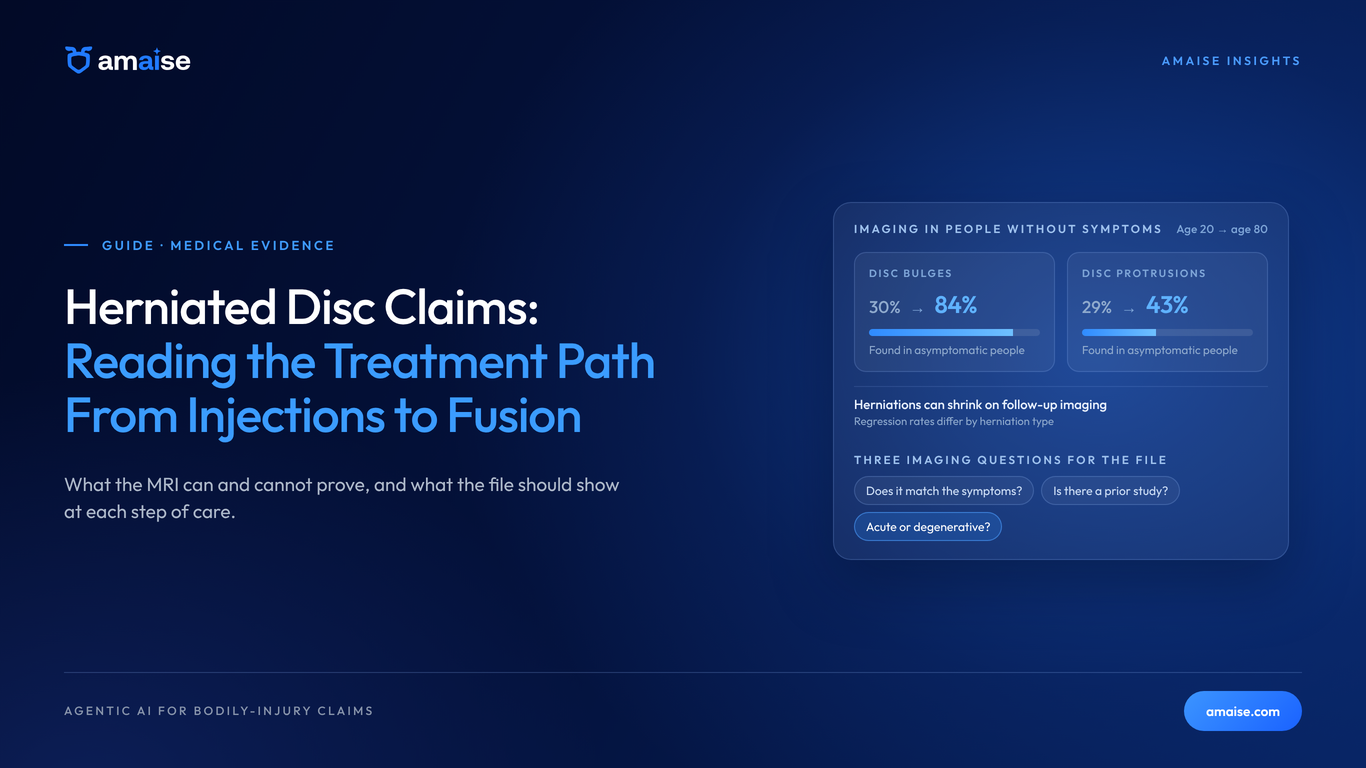
A 2015 systematic review in the American Journal of Neuroradiology pooled 33 studies covering 3,110 people without back pain (Brinjikji et al., AJNR 2015). Disc bulges appeared in 30 percent of these asymptomatic people at age 20 and 84 percent at age 80. Disc protrusions appeared in 29 percent at age 20 and 43 percent at age 80. The authors concluded that many imaging-based degenerative features "are likely part of normal aging and unassociated with pain."
The vocabulary itself is neutral on cause. The spine societies' shared nomenclature says its definitions "are not intended to imply external etiologic events such as trauma" (Lumbar Disc Nomenclature 2.0). An "extrusion" or "annular fissure" in a report describes shape. It does not say when or how the change happened.
Three imaging questions for the file
- Is there earlier imaging of the same region, and has anyone compared the two studies?
- Do the level and side of the finding match the symptoms the treating providers recorded?
- Does the radiologist describe the finding as acute, or as chronic degenerative change?
A separate guide on reading the MRI report for acute versus degenerative findings covers that third question and its terms in detail.
Herniations can shrink on follow-up imaging
Natural history matters for both causation and damages. A 2015 systematic review in Clinical Rehabilitation estimated how often lumbar herniations regress without surgery (Chiu et al., 2015). Reported regression rates were about 96 percent for sequestrations, 70 percent for extrusions, 41 percent for protrusions and 13 percent for bulges. Complete resolution was less common, at 43 percent for sequestrations and 15 percent for extrusions.
These figures measure change on imaging, pooled from different study groups. Imaging regression is not the same as symptom resolution or return to function. For the file, a follow-up MRI is one more data point for the reviewing physician, read alongside the symptoms.
Conservative care and physical therapy: the first chapter of the record
Conservative care usually comes first: medication, activity modification, chiropractic care and physical therapy. These records look routine and are easy to skim. They can hold some of the most useful causation facts in the file.
Onset and the first complaint
Read the first post-loss visit closely. Note when radiating symptoms first appear, such as leg or arm pain, numbness or weakness. A disc claim built on radiculopathy needs a radicular complaint in the record. If that complaint first appears weeks after the loss, the delay is a question for the reviewing physician.
Gaps, plateaus and prior care
Physical therapy notes record pain scores, range of motion and functional goals, visit by visit. Look for plateaus, missed sessions and the discharge summary. A gap of several weeks followed by renewed treatment can raise a question about intervening events. Earlier chiropractic care or therapy for the same region raises a prior-condition question.
A medical chronology built from the full claim file puts these entries in date order. Gaps, repeat complaints and changes in the described symptoms then become visible.
Epidural steroid injections: what the file should show
Injections can mark a step up in cost. In an epidural steroid injection settlement file, three questions matter. Why was the injection given, at which level, and what happened afterwards?
What the evidence says about benefit
A 2015 systematic review in Annals of Internal Medicine pooled placebo-controlled trials of epidural corticosteroid injections for radiculopathy (Chou et al., 2015). Injections were associated with immediate reductions in pain and improved function. The authors found the benefits were small and not sustained, with no effect on long-term surgery risk.
In 2014 the FDA required a warning on injectable corticosteroid labels about rare but serious neurologic events after epidural injection (FDA Drug Safety Communication, 2014). The same communication stated that the effectiveness and safety of epidural corticosteroid injection have not been established. It also noted that FDA has not approved corticosteroids for this use. None of this makes an injection improper. It shows why the indication should be written into the record, not assumed.
A documentation benchmark from one Medicare contractor
One Medicare contractor's local policy is a useful reference for what a documented injection looks like. Noridian, the contractor for Medicare Jurisdictions E and F, publishes it as LCD L39240 (CMS LCD L39240). The policy expects:
- Radicular pain lasting at least four weeks.
- Documented failure of, or intolerance to, four weeks of noninvasive conservative care.
- An objective pain or functional scale at baseline and again at each follow-up.
That policy governs Medicare payment in those jurisdictions, not liability claims. It has been revised several times, so check the current version. Two further points are common file-review practice rather than LCD text:
- Does the injection level match the imaging finding and the recorded symptoms?
- Does the record give a clinical reason for each repeat injection, tied to the response to the last one?
A hypothetical file
Consider an illustrative file, not a real claim. The MRI shows a left-sided protrusion at L4-5. The physical therapy notes record right leg pain. Three injections follow at L5-S1, with no pain scores recorded between them. None of these facts settles anything on its own. Each becomes a specific question for the reviewing physician: side, level and documented response.
Billing around the injection
One injection can produce several bills: physician, facility, anesthesia and imaging guidance. Check them against each other and against the billing patterns that signal duplicate charges or upcoding.
Care given under a letter of protection raises a billed-versus-paid question. What a jury may hear about those amounts depends on state law. For claims governed by Florida law, the 2023 amendments limit evidence of satisfied past medical expenses to the amount actually paid. The same statute sets disclosure rules for treatment under a letter of protection (Fla. Stat. 768.0427). Which version applies can depend on the claim's dates, so confirm current law with counsel. The guide on letters of protection, treatment stacking and billed versus paid covers this in more depth.
Microdiscectomy: when surgery enters the record
A microdiscectomy removes the part of the disc that presses on a nerve root. Neurosurgical guidance describes lumbar discectomy as the surgical option of choice for disc herniation (Wang et al., J Neurosurg Spine 2014). In the file, the surgical consult and the operative note carry the weight.
The consult should state the indication. Which symptoms persisted, for how long, and which conservative measures failed? The operative note should name the level and describe what the surgeon found. Compare both with the pre-operative MRI. A mismatch in level or side is a question for the reviewing physician.
Research comparing surgery with nonsurgical care is harder to read than it looks. The Spine Patient Outcomes Research Trial (SPORT) randomized patients with lumbar disc herniation to surgery or nonoperative care (Weinstein et al., JAMA 2006). Substantial crossover between the groups made the intent-to-treat comparison hard to interpret.
A companion SPORT cohort followed patients who chose their own treatment (Weinstein et al., JAMA 2006, observational cohort). Both groups improved, and those who chose surgery reported greater improvement in pain and function over two years. The authors cautioned that nonrandomized comparisons must be read carefully. For claims, surgery is a recognized path, and the record should show why it was chosen for this claimant.
Spinal fusion: why it needs its own justification
Fusion joins two or more vertebrae so the segment no longer moves. In a spinal fusion settlement file, the central question is why fusion was chosen over discectomy alone.
The 2014 lumbar fusion guideline update from the neurosurgical societies is direct on this point. It states that routine fusion with discectomy is not recommended (Wang et al., J Neurosurg Spine 2014). On low-level evidence, it treats fusion as an option when a herniation comes with instability, chronic low back pain or severe degenerative change. The 2014 North American Spine Society guideline found insufficient evidence for or against fusion in specific disc herniation groups (Kreiner et al., Spine J 2014).
Both documents address the lumbar spine. Cervical surgery follows its own conventions, so the reviewing physician should apply cervical guidance to a neck file.
Two causation questions inside the fusion indication
Read the stated reason for fusion carefully. It may name instability, chronic pain or degenerative change. These are clinical indications, not findings about timing.
Each can be degenerative, traumatic, or an aggravation of an earlier condition by the loss. Only the reviewing physician can say which, based on prior records and imaging. That leaves two causation questions. Did the loss cause the herniation? Did it cause, or aggravate, the condition that led to fusion?
A reviewing physician should answer both questions separately. How aggravation of a pre-existing condition is treated depends on the jurisdiction and the line of business. The guide on finding the prior injury before the IME does shows how prior records surface in a workers' comp file.
Fusion and the future care claim
Fusion files can include claims for future care, such as further surgery, hardware removal or ongoing pain management. Each projection should rest on a medical opinion tied to specific findings in the record. A projection without a documented basis belongs on the list of questions for physician review.
Reading the path for causation and damages
The table below pulls the stages together. It shows what each step should leave in the record and the questions it raises.
- MRI. What the record should show: Level, morphology, comparison with prior imaging. Causation question: Described as acute or chronic? Damages question: What do follow-up imaging and symptoms show together?
- Conservative care and PT. What the record should show: First radicular complaint, scores, gaps. Causation question: When did radicular symptoms start? Damages question: Did care plateau or end with a discharge note?
- Epidural steroid injections. What the record should show: Indication, level, scores before and after. Causation question: Does the level match imaging and symptoms? Damages question: Was each repeat justified by the last response?
- Microdiscectomy. What the record should show: Consult indication, operative findings. Causation question: Do operative findings match the MRI? Damages question: What do recovery and return-to-work notes say?
- Fusion. What the record should show: Reason for fusion over discectomy alone. Causation question: What does the record say about onset of the indication? Damages question: Are future care opinions tied to findings?
How general damages are valued is a separate topic. The treatment record is the evidence any valuation depends on.
Building the disc file for review
A herniated disc injury settlement file holds up best when every escalation has a documented reason. Five steps help:
- Request prior records and imaging for the same spinal region early.
- Build the chronology before the demand arrives, not after.
- Send the reviewing physician specific questions on level match, onset and the indication for each escalation.
- Separate causation of the herniation from causation of any fusion.
- Reconcile the bills for each procedure against the records of that procedure.
Long spine files can run to hundreds of pages. amaise Bodily Injury AI categorizes medical records and applies ICD-10 coding, and its findings link back to source pages. The adjuster and the reviewing physician still make the call.
The MRI opens a herniated disc settlement file, but the treatment path decides how well the file holds up. Read each step for its indication, its level and its documented response. That reading turns a stack of records into clear questions for the physician, defense counsel and the settlement decision.
Frequently asked questions
Does a herniated disc on an MRI prove an accident caused it?
No. A 2015 systematic review in AJNR found disc bulges and protrusions in many people without back pain, more often with age. The spine societies' disc nomenclature also states its terms do not imply trauma. Causation is a question for a physician who compares the imaging with prior studies and the recorded symptoms.
What should the records show before and after an epidural steroid injection?
The record should show a documented trial of conservative care and the reason for the injection. It should also show pain or function scores before and after each injection. File reviewers also check that the level matches imaging and symptoms, and that each repeat has a stated reason.
Why does a spinal fusion raise a separate causation question?
The 2014 neurosurgical fusion guideline update does not recommend routine fusion with discectomy. It treats fusion as an option with instability, chronic low back pain or severe degenerative change. Those indications can be degenerative, traumatic or an aggravation, so the reviewing physician should address fusion causation separately.
Do herniated discs shrink without surgery?
They can. A 2015 systematic review reported imaging regression in about 96 percent of sequestrations and 70 percent of extrusions. Rates were lower for protrusions, at 41 percent, and bulges, at 13 percent. Imaging regression is not the same as symptom resolution.
Key takeaways
- A herniated disc settlement file is about more than the MRI: each treatment step should be documented and tied to the loss.
- Disc bulges and protrusions are common in people without back pain, and disc terminology does not imply trauma.
- For each epidural steroid injection, check the indication, the level against imaging and symptoms, and pain or function scores.
- Neurosurgical guidance does not recommend routine fusion with discectomy, so a fusion needs its own stated reason in the record.
- Whether a fusion indication is degenerative, traumatic or an aggravation is a separate question for the reviewing physician.