Blog
November 4, 2026

by
Andrej Evtimov
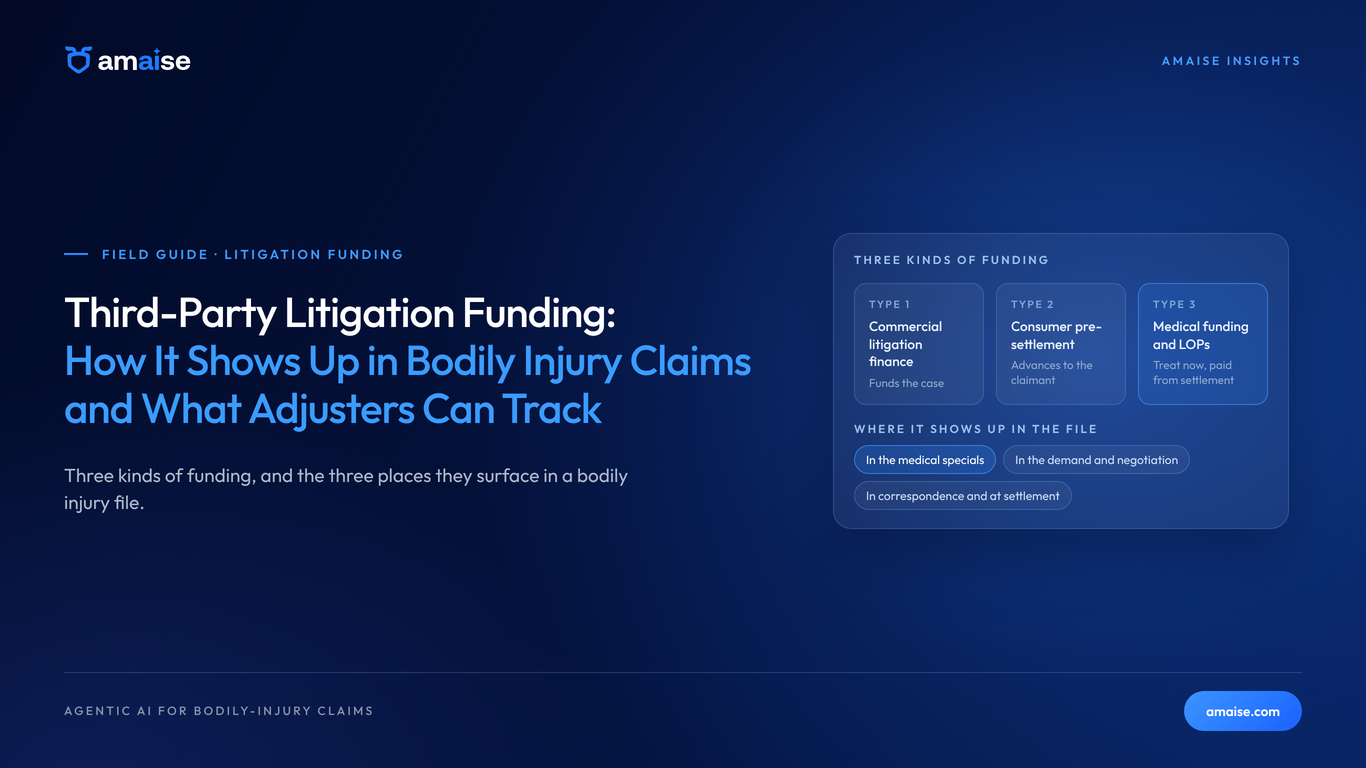
Three kinds of funding, and the three places they surface in a bodily injury file.
Third-party litigation funding rarely appears in a bodily injury file by name, but its effects often do. This post explains the funding types, selected disclosure rules and the file signals adjusters can record.
What third-party litigation funding is, and what it is not
Third-party litigation funding is money from an outside party, repaid only from a settlement or judgment. The funder is neither a party to the case nor the lawyer. If the case produces nothing, the funder usually recovers nothing.
The U.S. Government Accountability Office described the market in a December 2022 report. It found that federal law does not specifically regulate the industry. It also found that public data on it are limited.
This post uses "litigation funding" for every form of third-party money in a case. "Litigation finance" is the term used for the commercial market, including in Westfleet Advisors' data.
In a bodily injury file, funding can mean three different arrangements. Each one leaves different traces. This post is general information, not legal advice. State rules change, so confirm current law with counsel.
Commercial litigation finance
Commercial funders invest in single cases or in portfolios of cases, and some finance law firms directly. The adjuster almost never sees the agreement. In injury work, commercial money can reach the file indirectly, through a plaintiff firm whose caseload is financed. What the adjuster may see is an opponent with the cash to develop the case early and wait.
Consumer pre-settlement funding
Consumer funders advance cash to the injured claimant while the claim is open, for living costs or other expenses. Like other third-party funding, the advance is repaid only from a recovery.
Pricing and disclosure rules vary by state. West Virginia's code, for example, caps the annual fee a litigation financier may charge a consumer at 18% of the amount provided.
Medical funding and letters of protection
The third type sits inside the medical specials. A letter of protection (LOP) is an arrangement where a provider treats now and is paid later from the settlement or judgment. Some providers then sell those receivables to a factoring company for cash.
Florida added section 768.0427 in its 2023 amendments. It applies in personal injury and wrongful death actions and defines an LOP broadly. A claimant seeking medical expenses for LOP treatment must disclose the letter, coded itemized bills and the referral source. If the receivable was sold, the factoring company's name and the amount it paid must be disclosed too.
The billing side of LOP treatment has its own analysis. A related post on letters of protection, treatment stacking and billed vs paid covers it in detail.
How big is the litigation finance market?
The most-cited figures come from Westfleet Advisors. Westfleet tracks the U.S. commercial litigation finance market only. Consumer advances and medical receivable funding are not in its numbers.
- 2024: funders committed $2.3 billion to new deals, down 16% from 2023, per Bloomberg Law's coverage of the Westfleet report.
- 2025: new commitments rose about 23%, ending a two-year decline, per Risk & Insurance's coverage of the 2025 report, released in March 2026.
- Insurance on deals: about 21% of 2025 commitments were fully or partially insured, up from 19% in 2024, per the same Risk & Insurance report.
- Assets under management: Westfleet has stopped publishing this estimate, and its last figure was $16.1 billion for 2024, Risk & Insurance reported.
- Big Law share: the 200 largest U.S. law firms took about a quarter of 2025 commitments, per the ABA Journal. That was down from 37% a year earlier.
Two points matter for claims teams. First, the measured market is commercial, so it says little about what reaches a typical auto or general liability file. Second, GAO noted that figures such as funders' returns and total funding provided are not publicly available. Treat any single "injury funding market size" figure with care.
Litigation funding and social inflation: the link and its limits
Social inflation is the growth of liability claim costs beyond general economic inflation. Whether litigation funding drives it, and by how much, is debated. Attorney involvement, venue and jury attitudes are also part of that discussion.
The scale of the cost trend is documented. A 2025 analysis by the Insurance Information Institute (Triple-I), an insurance industry group, and the Casualty Actuarial Society measured it. The Triple-I and CAS analysis put the past decade's added liability losses at $231.6 billion to $281.2 billion. It attributed them to what it calls "legal system abuse," not economic inflation alone. It found that severity, not frequency, drives the increase.
Attorney involvement in auto injury claims also grew. The Insurance Research Council studied 7.4 million auto injury claims closed between mid-2017 and mid-2022. Over that window, representation rose from 40% to nearly 50%, and litigation from 10% to 18%. Represented claimants took a median of nearly 440 days to close, more than double the time for unrepresented ones. The data end in mid-2022, so they do not show more recent years.
Neither study isolates funding's share of the increase. Stakeholders interviewed by GAO described both sides. Funding can help underfunded plaintiffs litigate their cases. It is also expensive and may deter plaintiffs from accepting a settlement offer, because they want to cover what they owe the funder. Large jury verdicts belong to the same picture, but they are a separate topic.
For the adjuster, the practical point is narrower. Funding changes the economics on the other side of the file. That can affect timing, demand levels and the documents that arrive.
Where litigation funding disclosure rules exist
No national rule requires disclosure of funding. A patchwork of state statutes, federal local rules and judge-specific orders has grown since 2018. The table shows selected examples, not a complete list. Triple-I counts more than 20 states that now regulate litigation funding, Insurance Business reported. Scope, thresholds and effective dates differ, and rules change often, so confirm current law with counsel.
- Wisconsin. Year: 2018. What it does (summary): First state to require parties in civil cases to hand over funding agreements without a discovery request (Skadden).
- District of New Jersey (federal). Year: 2021. What it does (summary): Local Civil Rule 7.1.1 requires disclosure of third-party funding, including whether funder approval is needed for litigation or settlement decisions (court notice).
- District of Delaware (federal). Year: 2022. What it does (summary): Chief Judge Connolly's April 18, 2022 standing order requires parties to identify funders in his cases (Lake Whillans).
- West Virginia. Year: 2024 amendment. What it does (summary): Funding agreements go to other parties without a discovery request; consumer funders register (Insurance Journal).
- Indiana. Year: 2024. What it does (summary): Commercial funding agreements are discoverable; funding by a "foreign entity of concern" is barred (Insurance Journal).
- Louisiana. Year: 2024. What it does (summary): Existence of a funding contract is discoverable; funders may not control counsel, strategy or settlement (Verisk).
- Kansas. Year: 2025. What it does (summary): SB 54: a sworn statement on funding agreements, including any funder control rights, within 30 days (Kansas Legislature).
- Georgia. Year: 2025. What it does (summary): SB 69: funder registration from January 1, 2026; existence and terms of funding contracts are discoverable (Epstein Becker Green).
Medical funding has its own rules. Florida's section 768.0427 reaches LOPs and sold receivables, as described above. Georgia's Senate Bill 68 (2025) makes LOP agreements and amounts of receivables sold to third parties relevant and discoverable.
Outside these rules, disclosure depends on the court and the judge. GAO noted that some courts require it, but there is no national requirement.
How litigation funding shows up in a bodily injury file
The agreement is rarely in the file. Its effects often are. The signals below are practical indicators drawn from the document trail, not a validated test. Funding is lawful, and none of them proves funding on its own. Each is a reason to look closer and record what you find.
In the medical specials
- Treatment billed under an LOP, with no health insurance billing even though the claimant has coverage.
- Bills naming an assignee, purchaser or servicing company that differs from the treating provider.
- Full billed charges with no adjustments, write-offs or payments recorded.
- Referral chains: the same firm, imaging center and surgeon recurring across many claims.
In the demand and the negotiation
- Early, costly case development out of proportion to the documented injury, such as retained experts or a life care plan.
- A demand that holds firm despite treatment gaps or weak causation evidence. Many factors can explain this, and funding is only one.
- A time-limited demand. Funded or not, the deadline and any state rules on these demands still apply, so the 30-day playbook for time-limited demands stays relevant.
In correspondence and at settlement
- Lien notices or payoff letters from funding companies.
- Requests to add a payee to the settlement check.
- In jurisdictions with disclosure rules, a disclosure statement or the agreement itself in discovery.
A hypothetical file
Consider an illustrative auto claim, not a real case. The claimant has health insurance but treats at a clinic under an LOP. Weeks later, the bills arrive from a company that is not the clinic. After the demand, a lien letter from a funding company follows.
None of this proves anything improper. The adjuster records LOP treatment, the receivable purchaser and the funder lien in structured fields. Defense counsel then checks whether a medical funding statute or disclosure rule applies in the venue.
What adjusters can track: a file-level checklist
Tracking works best as structured fields, not notes buried in a diary entry. Consistent fields let a claims leader see patterns across a book, by firm, provider or venue. One file shows little. Many files can show a pattern.
Fields to capture on each file
- LOP treatment (yes or no, provider, dates). Why it matters: Florida and Georgia make LOP details disclosable or discoverable.
- Billed amount and paid amount. Why it matters: Florida limits evidence of satisfied past medical expenses to amounts actually paid.
- Receivable sold (purchaser, amount if disclosed). Why it matters: Florida requires the factoring company and purchase amount; Georgia SB 68 reaches receivable sales.
- Referral source. Why it matters: Florida makes evidence of an attorney referral admissible.
- Funding disclosure received (date, rule applied). Why it matters: Shows whether a jurisdiction's rule was used and when.
- Representation date and suit date. Why it matters: IRC data tie representation to much longer claim duration.
- Funder liens or payee requests at settlement. Why it matters: These can delay closing and add parties to the settlement paperwork.
Questions for defense counsel
- Does this jurisdiction require or permit disclosure of funding, and has it been requested?
- Does a medical funding or LOP statute apply to the specials?
- Does any funder hold control or approval rights over settlement? Kansas requires that to be stated.
- Does what was disclosed change the reserve or the settlement strategy?
Reporting it up
Funding indicators belong in the reserve rationale. A file with LOP treatment and sold receivables can show billed specials far above the amount paid. Whether billed or paid amounts drive damages depends on state law. The reserve note should say which figure was used and why. A related post on reserve accuracy from day one explains why early file review matters here.
These signals sit across many pages: bills, correspondence, lien letters and provider records. amaise's Bodily Injury AI processes the unstructured documents in injury claims and categorizes medical records with ICD-10 coding. Findings stay traceable to the source page, as the agentic AI platform page describes. The software extracts and organizes the documents. The adjuster decides what each signal means.
Third party litigation funding: what the file can and cannot show
The file will rarely prove that a case is funded. It can show the structure around the claim: who treated, who is owed, who bought the receivable and when representation began. Those facts are worth recording whether or not funding is ever confirmed.
Third party litigation funding is one possible input to social inflation, not the whole story. Treat it as a set of observable signals, track them in structured fields, and let defense counsel apply the disclosure rules that fit the venue.
Frequently asked questions about litigation funding
Is third-party litigation funding legal in bodily injury cases?
No federal law specifically regulates it, according to GAO. States regulate it in different ways, from consumer funding statutes to disclosure rules and limits on funder control. Whether a specific arrangement is permitted is a state-law question for counsel.
Can an adjuster ask whether a claimant has litigation funding?
Whether and how to ask is a question for defense counsel and company claims-handling guidelines. After suit is filed, disclosure depends on the jurisdiction's statutes, local rules and the judge. Formal requests are best handled through defense counsel.
Does Westfleet's litigation finance data include consumer funding?
No. Westfleet Advisors tracks the U.S. commercial litigation finance market. Consumer pre-settlement advances and medical receivable funding are outside those figures.
How is a letter of protection related to litigation funding?
A letter of protection lets a provider treat now and be paid from the settlement or judgment. When the provider sells that receivable, a third party holds a financial interest in the outcome. Florida and Georgia make details of these arrangements disclosable or discoverable.
Key takeaways
- Third-party litigation funding takes three forms that matter to injury files: commercial litigation finance, consumer pre-settlement advances and medical funding tied to letters of protection.
- Westfleet Advisors' market data cover U.S. commercial litigation finance only, so consumer and medical funding sit outside the most-cited figures.
- Disclosure rules are a changing patchwork of state statutes, federal local rules and judge-specific orders, so confirm current law with counsel.
- The funding agreement is rarely in the file, but its traces often are: LOP billing, sold receivables, assignee names on bills and funder liens.
- Structured file fields for these signals let claims leaders see patterns by firm, provider and venue, and support reserve and large loss reporting.