Blog
December 17, 2025

by
Scott Francis
Discover how AI helps insurers reduce bodily injury claim costs with faster, accurate, and fair claims management.
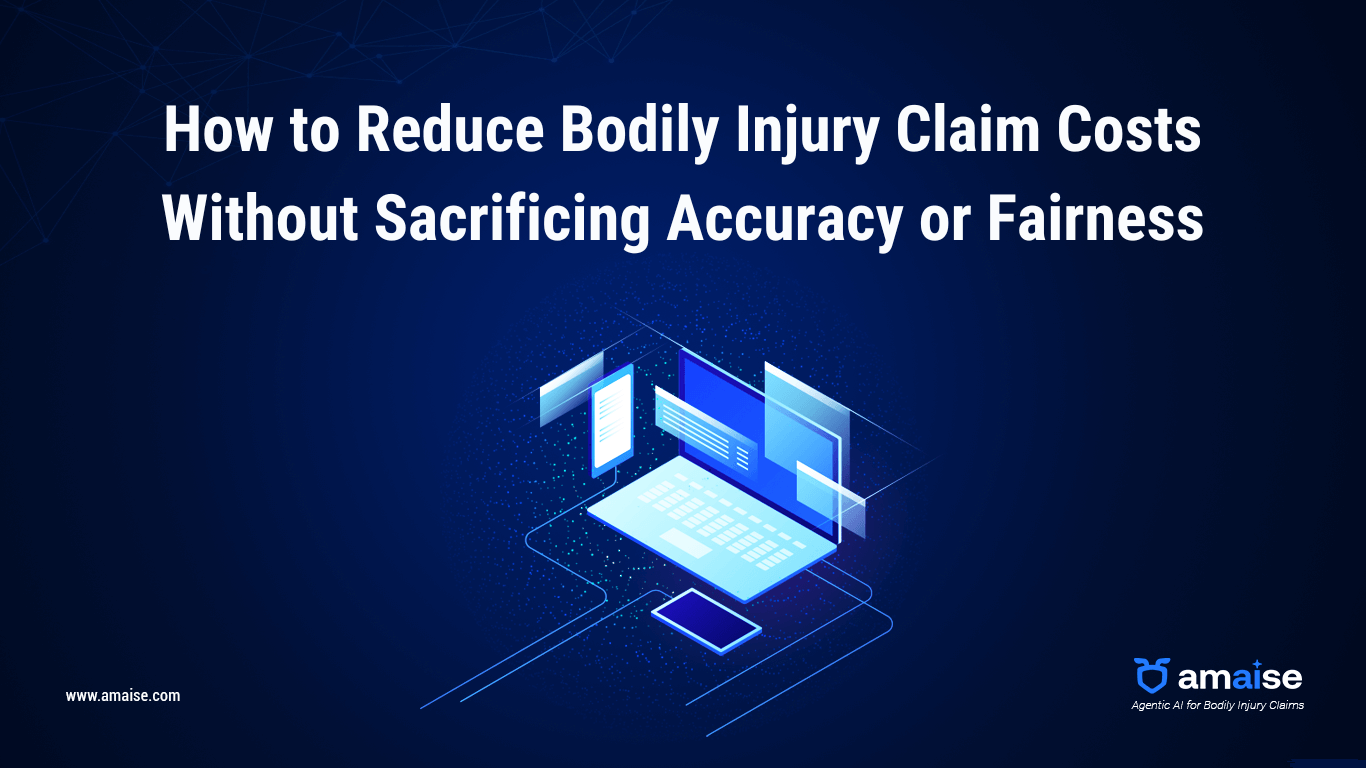
For insurance carriers and claims leaders, bodily injury claims represent one of the largest and most volatile sources of loss. Rising medical costs, prolonged treatment cycles, social inflation, litigation pressure, and inconsistent injury evaluations all contribute to escalating expenses. As a result, one question continues to dominate executive and operational discussions:
How can insurers reduce bodily injury claim costs while maintaining fairness, compliance, and accuracy?
The answer increasingly lies in the strategic use of artificial intelligence (AI) and automation. Not as a replacement for human expertise, but as a force multiplier that transforms how injury claims are analyzed, managed, and resolved.
In this article, we’ll explore ways insurers can use AI to reduce bodily injury claim costs, improve operational performance, and strengthen outcomes across the entire claims lifecycle.
Why Bodily Injury Claim Costs Keep Rising
To solve the problem, we first need to understand what drives cost pressure in bodily injury claims.
First, medical inflation continues to outpace general inflation. Advanced diagnostics, extended therapy, and procedural costs directly push claim severity higher.
Second, longer claim durations lead to higher indemnity and expense spend. The longer a claim remains open, the more it costs medically, legally, and administratively.
Third, inconsistent injury evaluations across adjusting teams lead to reserve volatility, overpayments, and settlement inefficiencies. Fourth, social inflation and litigation funding create upward pressure on settlements, even in cases involving moderate injuries.
Finally, most carriers still rely on manual document review across massive medical files, which slows investigations, increases error rates, and burdens adjusters with administrative work instead of decision-making.
Together, these factors create a dangerous combination: higher severity, slower settlements, and greater financial uncertainty.
The Real Cost of Manual Claims Handling
Manual claims processing is not just slow, it’s expensive.
Adjusters often spend hours reviewing unstructured medical files, surgical notes, imaging reports, and treatment timelines just to answer basic questions:
- What injuries were actually sustained?
- Are there pre-existing conditions?
- Is the treatment consistent with the accident?
- Is there causation or contradiction?
When these answers arrive late, several costly outcomes follow:
- Delayed settlements
- Over-reserving
- Unnecessary medical spending
- Higher litigation involvement
- Increased leakage
Manual workflows also make it extremely difficult to apply consistent standards across large claims teams. Two adjusters reviewing the same injury file can arrive at materially different conclusions, creating operational risk and financial exposure.
This is exactly where AI changes the equation.
How AI Helps Reduce Bodily Injury Claim Costs
Artificial intelligence introduces speed, structure, and consistency into the most complex part of claims handling: understanding medical and legal data at scale.
Here is how AI delivers measurable cost reduction across bodily injury portfolios.
1. Faster Injury Analysis and Triage
AI can review entire medical files in minutes, not days. It automatically:
- Extracts diagnoses and procedures
- Identifies injury severity
- Flags inconsistencies
- Detects prolonged or unnecessary treatment patterns
This acceleration enables early claim direction, which is one of the most powerful cost-control levers in bodily injury claims. Early insight leads to better reserves, faster negotiations, and lower ultimate loss.
2. Reduced Overpayments Through Medical Intelligence
Overpayments often occur not because of fraud, but because of information gaps. AI fills those gaps by:
- Detecting pre-existing conditions
- Highlighting gaps between injury and treatment
- Identifying non-causal procedures
- Flagging overlapping or excessive therapies
With these insights, adjusters can negotiate from evidence and not assumptions, which leads to fair, defensible settlements that avoid unnecessary payouts.
3. Greater Accuracy and Consistency at Scale
AI enforces consistency across teams by applying the same analysis logic to every claim file. This reduces:
- Adjuster-to-adjuster variability
- Reserve instability
- Inconsistent settlement outcomes
Consistency directly translates into predictable loss performance, which improves actuarial confidence and underwriting stability.
4. Lower Operational Expenses
When AI automates document intake, extraction, and summarization, adjusters spend less time on clerical tasks and more time on:
- Strategy
- Negotiation
- Stakeholder communication
- Complex decision-making
This increases claims throughput without increasing headcount, creating a critical efficiency advantage for large-scale claims operations.
5. Shorter Claim Lifecycles
Every additional day a bodily injury claim remains open adds cost. AI shortens lifecycles by speeding up:
- Injury review
- Medical interpretation
- Decision documentation
- Evidence-based settlement preparation
Shorter cycles mean lower indemnity, lower ALAE, and higher customer satisfaction.
Automation vs. Intelligence: Why Both Matter
Many carriers already use automation in claims, but not all automation is equal.
Basic automation focuses on task execution:
- Uploading documents
- Routing files
- Sending notifications
AI-powered intelligence goes further:
- It understands the content and context of medical and legal data.
- It links injuries to causation.
- It evaluates treatment relevance.
- It supports real-time decision-making.
The most effective organizations combine workflow automation with cognitive AI. This blend drives both:
- Operational efficiency
- Claims accuracy and cost control
Where amaise Naturally Fits Into This Evolution
As claims operations evolve, many insurers are turning to domain-specific AI platforms designed for bodily injury and complex medical claims.
This is where solutions like amaise enter the picture. Not as generic automation tools, but as claims intelligence platforms purpose-built for injury analysis.
Rather than simply processing documents, amaise focuses on:
- Structuring unstructured injury data
- Creating a complete medical and legal case understanding
- Enabling adjusters to navigate massive files with instant clarity
- Supporting evidence-based decisions across the claim lifecycle
For claims leaders, this type of platform represents a shift from reactive claims handling to proactive, intelligence-driven operations without removing human expertise from the equation.
The Role of AI in Fair and Defensible Settlements
A common misconception is that cost reduction conflicts with fairness. In reality, the opposite is often true.
AI improves fairness by:
- Anchoring decisions in documented medical facts
- Eliminating subjective guesswork
- Applying consistent criteria across all claimants
- Making evaluation methodologies transparent for audits and disputes
When both sides understand how an injury conclusion was reached, settlements become faster, more predictable, and less adversarial. Litigation rates drop, and reopened claims decline. This leads to improved trust.
And trust, ultimately, is one of the most powerful cost-control mechanisms in claims.
Practical Steps to Reduce Bodily Injury Claim Costs With AI
For carriers ready to take action, here is a practical roadmap.
Step 1: Centralize Injury Data
Bodily injury data typically lives in disconnected formats:
- PDFs
- Medical images
- Scanned notes
- Emails
- External provider reports
AI needs centralized access to build a complete injury picture. Start by unifying data ingestion.
Step 2: Apply Structured Medical Coding
AI-driven ICD-10 coding and injury classification bring structure and comparability to claims data. This enables:
- Portfolio-level injury analysis
- Trend detection
- Predictive risk modeling
Step 3: Enable Real-Time Medical Summarization
Adjusters should no longer wait days for medical summaries. Instant summaries unlock:
- Faster reserve accuracy
- Quicker negotiation readiness
- Reduced expert review cycles
Step 4: Automate Large-Loss and Litigation Triggers
AI can detect:
- Attorney involvement
- Surgical escalations
- Excess exposure thresholds
This enables earlier intervention by senior adjusters and legal teams before costs spiral.
Step 5: Measure What Changes
Track the impact of AI on:
- Average claim cycle time
- Medical spend per claim
- Litigation rates
- Reserving accuracy
- Adjuster productivity
Cost reduction becomes repeatable when it is measurable.
The Strategic Advantage of Data-Driven Claims Leadership
Claims operations are no longer just a back-office function. They are a strategic profit lever. Organizations using AI-driven claims intelligence gain:
- Lower combined ratios
- More stable reserves
- Better reinsurance positioning
- Stronger customer retention
- Higher staff satisfaction
And perhaps most importantly, they gain control over bodily injury cost volatility, which remains one of the most difficult variables in insurance profitability.
Looking Ahead: The Future of Bodily Injury Claims
The next generation of claims operations will not be built on manual review, scattered data, and reactive decisions. It will be built on:
- Continuous AI-supported insight
- Automated medical intelligence
- Evidence-based settlement strategies
- Real-time performance visibility
Platforms like amaise reflect this broader shift toward claims-as-intelligence, where every decision is supported by structured medical and legal data, not fragmented documents.
For forward-looking claims leaders, the question is no longer whether AI will shape bodily injury claims, but how quickly they will capture its competitive advantage.
Final Thoughts: Reducing Bodily Injury Claim Costs the Smart Way
To reduce bodily injury claim costs sustainably, insurers must address the root causes of inefficiency, including manual medical review, inconsistent evaluations, delayed decision-making, and limited data visibility. AI and automation directly tackle these challenges by providing faster insights, greater accuracy, and scalable consistency.
For claims leaders seeking to improve performance without increasing risk, AI offers a rare combination of lower costs, enhanced fairness, and stronger operational control.