Blog
October 6, 2026

by
Andrej Evtimov
28 claims terms and 12 AI terms, each defined in plain English.

Claims work has its own vocabulary and so does AI, and a claims leader evaluating a document-review tool is expected to hold both at once. This page defines 40 terms in plain English, each one written to stand on its own.
A shared vocabulary for two conversations that now happen in one room
Claims work has its own vocabulary. So does AI. A claims leader evaluating a document-review tool is expected to hold both at once, usually in a meeting where nobody defines anything.
This page defines 40 terms in plain English: 28 from claims practice and 12 from AI. Each definition stands on its own, so a term can be quoted without the paragraph around it. Where a term has a longer treatment elsewhere on this blog, the term links to it.
Where a regulator or a standards body defines a term, that definition is quoted and linked. The rest are working definitions for practice, not for a statute.
Claim file and documents
Demand package
The settlement demand sent by claimant's counsel, with the medical records, bills and wage loss documents attached. The medical expense total inside it, the medical specials, is the anchor for negotiation. A demand package is an argument assembled from documents, not a neutral file.
Medical chronology
A date-ordered summary of every clinical encounter in the file, with a page citation for each entry. It is an evidentiary document, not a reading aid, so entries have to use the record's language rather than a summarizer's.
CMS-1500 and UB-04
The two standard billing forms in US healthcare. Professionals bill on the CMS-1500; hospitals and facilities bill on the UB-04, also called the CMS-1450. Both forms for one date is normal, because the physician and the facility bill separately. The same procedure code from the same provider on both is the thing to check.
Time-limited demand
A settlement demand that expires on a stated date, often 30 days out. The deadline, not the number, is the exposure, because a missed response can expose the carrier to bad-faith allegations beyond policy limits.
Letter of protection (LOP)
An undertaking, usually given by the claimant's attorney, that a treating provider will be paid out of any recovery. The provider treats without payment at the time of service. No payer reviews the charge when the care is given.
Billed versus paid
The gap between what a provider charged and what was actually accepted as payment. Which figure is admissible varies by state, which is why the same file is worth different amounts in different venues.
Independent medical examination (IME)
An examination of the claimant by a physician retained by the carrier or ordered by a court. The report is one opinion in the file, and it is only as strong as the records the examiner was given.
Life care plan
A costed projection of a claimant's future medical needs, often the largest single line in a catastrophic claim. Each item has a unit cost, a frequency and a duration, and each of those is checkable.
Medical and causation terms
Mild traumatic brain injury (mTBI)
A head injury whose severity, measured in the first hours, falls in the mild band. That band is a Glasgow Coma Scale score of 13 to 15. Under the 2023 criteria of the American Congress of Rehabilitation Medicine, the diagnosis also needs clinical signs, acute symptoms or clinical findings (Living Concussion Guidelines). Mild grades the injury event, not the claim.
Glasgow Coma Scale (GCS)
A severity score recorded at the scene and on arrival. It sums eye opening (1 to 4), verbal response (1 to 5) and motor response (1 to 6), for a total of 3 to 15. The TRACK-TBI study defined its mild TBI cohort as GCS 13 to 15 (JAMA Neurology, 2019).
Degenerative finding
A change in the spine or a joint that developed over time rather than in an event. Such findings are common in people with no symptoms. Disc degeneration appears in 37% of asymptomatic 20-year-olds and 96% of 80-year-olds (Brinjikji et al., AJNR, 2015). A degenerated segment can still be aggravated by a trauma, which is a separate question.
Disc bulge, protrusion and extrusion
Three descriptions of disc shape on imaging, usually stated in the impression of the radiology report. A bulge is broad, extending around more than a quarter of the disc circumference, and is not classed as a herniation. A protrusion is focal, and its base is wider than the part that extends beyond the disc space. An extrusion is wider than its base. The task forces behind the nomenclature state that these definitions "are not intended to imply external etiologic events such as trauma" (Lumbar Disc Nomenclature: Version 2.0).
Apportionment
Dividing a disability between the current injury and other causes, such as a prior injury or a degenerative condition. The term is most developed in workers' compensation, where the employer carries the burden on the non-industrial share. Liability files reach the same question through causation and apportionment of fault. The rules differ sharply between states, so apportionment law does not travel.
Pre-existing condition
A condition present before the loss. A degenerative finding on imaging is evidence of pre-existing anatomy. Whether it was symptomatic before the loss is a separate question, answered from the treatment record. A pre-existing condition does not by itself defeat a claim, because aggravation of it can be compensable.
Performance validity test (PVT) and symptom validity test (SVT)
Measures used in neuropsychological testing to check whether scores and reported symptoms can be relied on. Failing one is not proof of intent: "malingering requires intentionality," and the only statistical proof of it is below-chance performance (Brain Injury, 2015).
Post-concussion symptoms
Headache, fatigue, poor concentration, irritability and sleep disturbance after a head injury. They are also common in adults with no head injury. In one study of 11,759 general-population respondents, 41.4% reported fatigue and 35.8% reported headaches (Journal of Clinical Medicine, 2022).
Aggravation
The worsening of a pre-existing condition by the loss. It is a distinct theory of damages from causing the condition, and it keeps a claim alive where the underlying anatomy predates the accident.
Upcoding and unbundling
Two billing patterns. Upcoding bills a service at a higher level than the documentation supports, most often an evaluation and management (E/M) visit. Unbundling bills component parts separately when one comprehensive code covers them. Medicare screens for the second with procedure-to-procedure edits, "automated prepayment edits that prevent improper payment when you report certain codes together" (CMS). In liability claims neither pattern is screened at all, because no payer adjudicates the bills.
Exposure, money and compliance
Reserve development
The movement of a claim's reserve between the initial estimate and the final paid amount. Development is adverse when the reserve rises and favorable when it falls. Causes include new facts, injury progression, litigation and late review.
Social inflation
An industry term for rising claim severity attributed to factors other than economic and medical cost inflation. Litigation funding, attorney involvement and jury attitudes are the ones usually named. The drivers are contested, and the term is used differently by different parties.
Nuclear verdict
A jury award far above the historical range for comparable injuries. There is no agreed threshold, and industry commentary commonly uses $10 million or more as a working convention. Its practical effect is on the settlement value of similar pending files.
Large loss notice (LLN)
The report produced when a claim crosses a severity threshold, summarizing exposure, liability, damages and strategy. The internal version goes to senior management; a separate notice may be owed to reinsurers under the treaty.
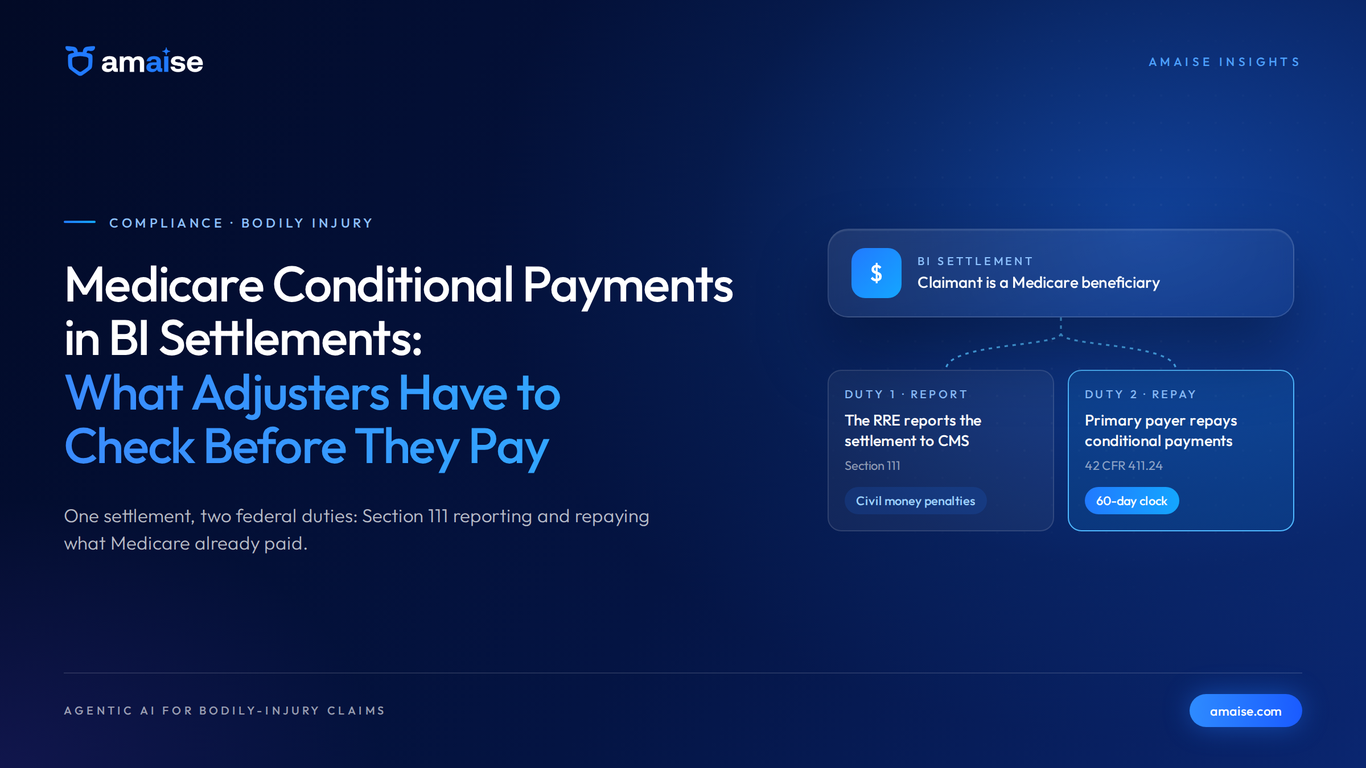
Medicare conditional payment
A payment Medicare makes for treatment another payer should have covered, conditional on repayment. Repayment is not only the claimant's problem. Under 42 CFR 411.24(i)(1), "the primary payer must reimburse Medicare even though it has already reimbursed the beneficiary or other party" (GovInfo).
Section 111 reporting
The duty of a responsible reporting entity to report a settlement involving a Medicare beneficiary to CMS. It is separate from repayment, and satisfying one does not satisfy the other.
Civil money penalty (CMP)
The penalty CMS may impose for late Section 111 reporting. As published in September 2026, the base amounts run from $250 to $1,000 per calendar day. They are adjusted annually for inflation, to a maximum of $365,000 per instance (CMS). Check the current figures before relying on them.
Reptile theory
A plaintiff trial strategy that reframes a specific injury as a community safety risk. It invites the jury to punish conduct rather than compensate loss, and it appears in demand packages as safety-rule language before it appears at trial.
Venue risk
The effect of the court location on the likely outcome and value of a claim. It is a distribution, not a verdict, so a venue's reputation is a reason to prepare differently, not a prediction about one file.
NAIC AI model bulletin
Model guidance adopted by the National Association of Insurance Commissioners on December 4, 2023. It is a model, so it binds insurers only where a state adopts or issues its own version. It sets expectations for insurers using AI systems, including a written AI systems program. Decisions supported by such technologies "must comply with all applicable insurance laws and regulations" (NAIC).
AI terms, in claims language
AI system
A machine-based system that produces outputs such as predictions, recommendations or generated content that influence decisions. In a claims context, the relevant question is which decision the output feeds, and who makes it.
Machine learning (ML)
A field of AI in which a system learns patterns from data rather than following rules written by hand. A model trained on one carrier's claim mix will not necessarily behave the same way on another's.
Large language model (LLM)
A model trained on large volumes of text that generates language by predicting the next piece of text. It has no independent knowledge of a specific claim. Anything it states about a file has to come from documents put in front of it.
Generative AI
AI that produces new content, such as text or images, rather than only classifying or scoring existing content. A drafted summary is generated content, and it needs checking against the source.
Optical character recognition (OCR)
Converting scanned images of documents into machine-readable text. Claim files are full of faxes, handwriting and photocopies, so OCR quality sets a ceiling on everything downstream.
Extraction
Pulling specific structured facts out of unstructured documents, such as dates of service, diagnosis codes, provider names and payment amounts. It usually follows classification, which sorts a mixed file into document types. The output is a table built from prose, and it is only checkable if each value records where it came from.
Knowledge graph
A data structure of nodes and edges, where nodes are entities such as people, providers, dates and diagnoses, and edges are the relationships between them. It can be queried. In a claim file it is what allows a question to be answered across documents rather than within one.
Retrieval-augmented generation (RAG)
A method in which a system first retrieves relevant passages from a document set, then generates its answer from them. It is meant to tie answers to the source material. It reduces unsupported output rather than removing it, because retrieval can return the wrong passage.
Hallucination (confabulation)
A confidently stated but false output. NIST defines confabulation as "the production of confidently stated but erroneous or false content." It notes these are "known colloquially as 'hallucinations' or 'fabrications'" (NIST AI 600-1).
Source citation
A reference from a generated statement to the passage that supports it, sometimes presented as a link into the source page. A citation shows where an answer came from. It does not show that the answer is correct, which is why a reviewer still opens the page.
Human-in-the-loop
A design in which a person reviews, approves or acts on the system's output, and remains the decision-maker. The review has to be real to count, because reviewers tend to defer to automated output, a pattern known as automation bias.
Vendor security review
The assessment an IT and governance team runs before a claims AI tool is approved. It covers data residency, meaning the country and jurisdiction where data is stored and processed. It also covers access control, retention, subprocessors, and whether claim data is used to train models.
How to use this page
Three uses for a glossary like this one.
- In vendor conversations. When a demonstration uses one of the AI terms above, ask which claims term it touches. Then ask to see the citation behind an answer.
- In onboarding. New adjusters and new technology staff usually know one half of this list. The other half is the half they will be expected to use in meetings.
- In writing. Claim files, large loss notices and coverage letters travel to readers who do not share the writer's vocabulary. A defined term is easier to defend than a shorthand one.
Definitions here are working definitions, checked against the sources cited. Where a term carries a legal or clinical meaning in a specific matter, the file's counsel and the reviewing physician settle it.
Key takeaways
- 40 definitions on one page: 28 from claims practice and 12 from AI, each written to be quoted without the paragraph around it.
- Where a regulator or a standards body defines a term, the definition is quoted and linked, including CMS on procedure-to-procedure edits, NAIC on AI systems and NIST on confabulation.
- Claims terms cover the file (demand package, medical chronology, letter of protection), medical causation (mild TBI, Glasgow Coma Scale, degenerative findings, aggravation) and exposure (reserve development, nuclear verdict, Medicare conditional payments, Section 111).
- AI terms are defined neutrally, including the limits: a source citation shows where an answer came from, not that it is correct, and retrieval-augmented generation reduces unsupported output rather than removing it.
- Terms with a longer treatment elsewhere on this blog link to it, so the glossary works as a hub as well as a reference.